
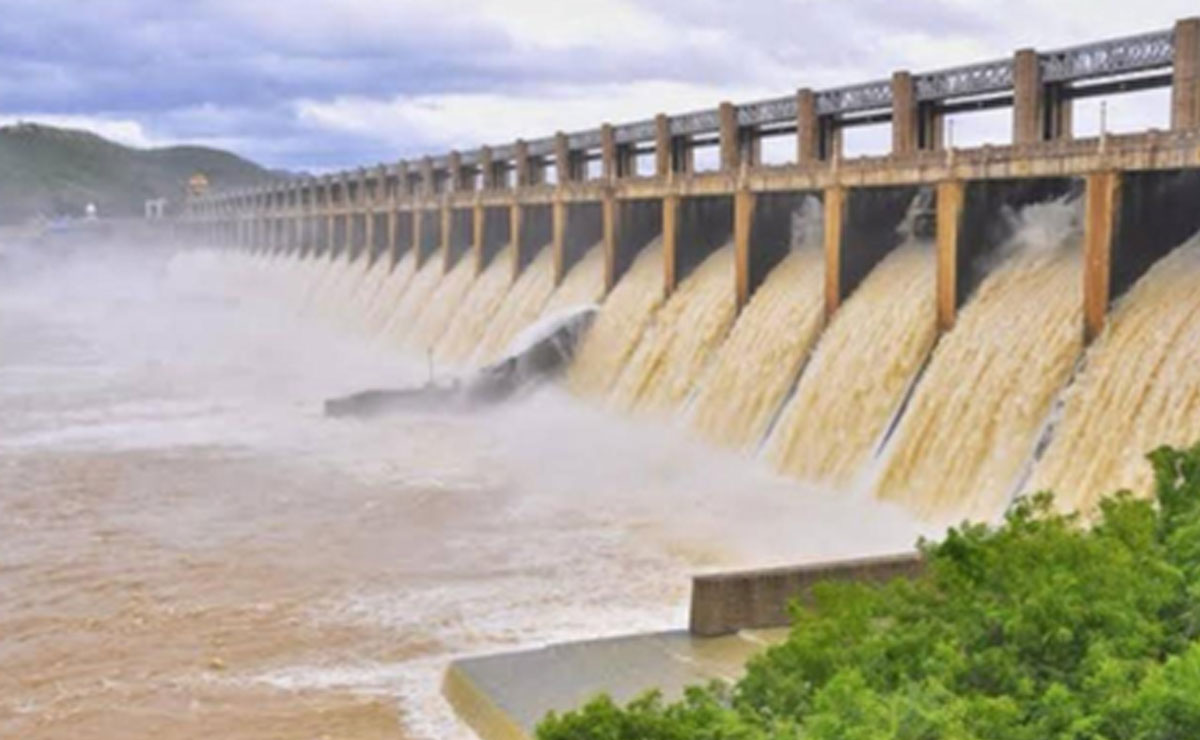
Chennai: Northeast monsoon showers over the past two months have boosted water storage levels across Tamil Nadu, giving the state a comfortable buffer for both drinking water supply and agricultural needs in the months ahead. Reservoirs in almost every region have recorded steady inflows, with officials describing this year’s storage as one of the strongest in recent times. Latest data from the Water Resources Department (WRD) shows that Tamil Nadu’s 90 reservoirs together hold 195.835 TMC ft of water as of December 5 – equivalent to 87.29 per cent of their total capacity of 224.343 TMC ft.
This is a substantial rise from October 5, when storage stood at just 78.55 per cent before the monsoon set in. Reservoir levels are also significantly higher than the same period last year, when storage was at 80.43 per cent. “The increase in storage is clearly visible, and this year’s monsoon has performed better for most basins,” a senior WRD official said. Of the 90 reservoirs monitored, nine, including Gundar in Tenkasi and Sothuparai in Theni, have reached full capacity.
Also Read: Sitharaman praises Omar Abdullah for ‘focused’ approach to restore J-K’s economy
Another 34 reservoirs are almost at the brim with 99.76 per cent storage. Authorities have placed 18 reservoirs on red alert for exceeding 95 per cent capacity and 10 more on orange alert with storage levels between 90 per cent and 95 per cent. Engineers noted that these alerts are precautionary and part of standard reservoir management protocols during active monsoon conditions. In the Chennai region, the Red Hills reservoir in Tiruvallur district, one of the city’s most crucial drinking water sources, has been classified under red alert.
Officials said there is no immediate cause for concern, as the alerts help regulate inflow and outflow efficiently. The reservoir currently holds 3.144 TMC ft of water – 95.27 per cent of its total capacity of 3.300 TMC ft. Its catchment also received 40 mm of rainfall in the 24 hours ending 6 a.m. Thursday, the second-highest in the state. Cholavaram reservoir recorded the highest rainfall at 51 mm.
On the irrigation side, 15 major reservoirs, including Mettur, Bhavanisagar, and Amaravathi, have reported better storage compared to last year, offering relief to farmers in the delta and western districts. Officials said the improved water availability will support ongoing and upcoming agricultural cycles. With the northeast monsoon still active in several pockets of the state, WRD engineers expect further inflows in the coming days, strengthening Tamil Nadu’s water security for the season ahead.
For More Update Visit Munsif News 24×7 (Website) (@MunsifNewsDesk) / X