
Dense smog, fog blanket Delhi as air quality remains poor; IMD issues Yellow Alert
Prominent landmarks such as Rashtrapati Bhawan and India Gate were shrouded in thick haze, while visibility on Kartavya Path dropped sharply, leading to traffic slowdowns and travel disruptions.

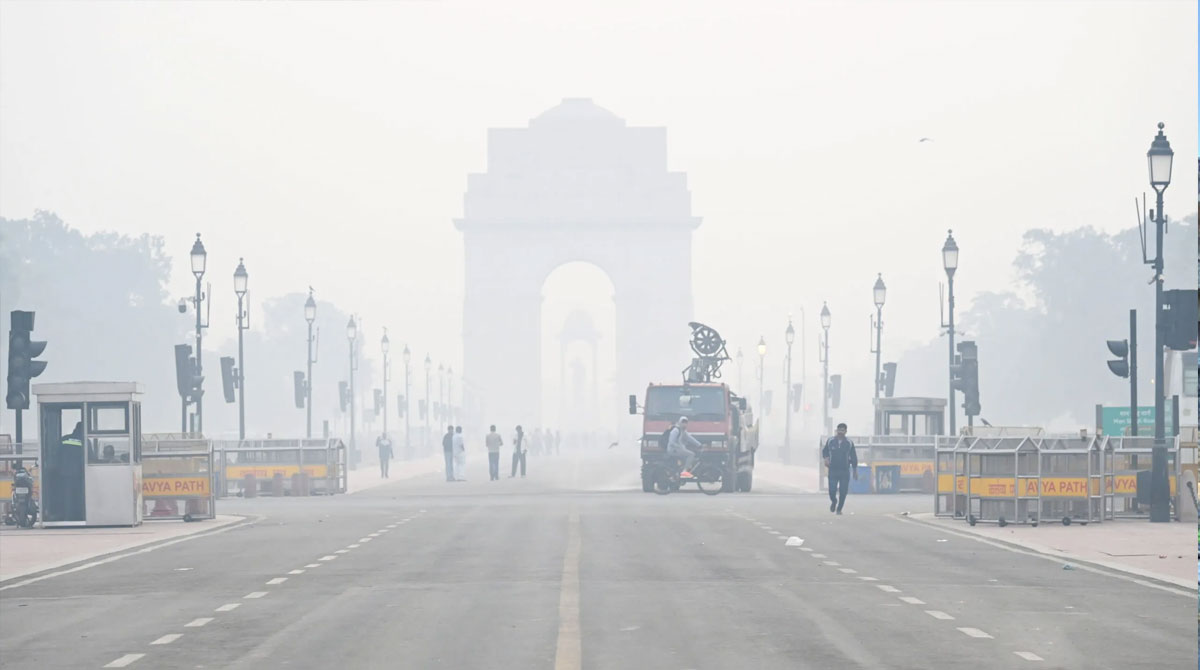
New Delhi: Dense smog and fog enveloped large parts of the national Capital on Saturday morning, significantly reducing visibility and affecting daily life across the city.
Prominent landmarks such as Rashtrapati Bhawan and India Gate were shrouded in thick haze, while visibility on Kartavya Path dropped sharply, leading to traffic slowdowns and travel disruptions.
According to data from the Central Pollution Control Board (CPCB) accessed through the SAMEER app, Delhi’s Air Quality Index (AQI) was recorded at 235 on Saturday morning, placing it in the ‘poor’ to ‘very poor’ category. Authorities have advised residents, particularly children, the elderly, and those with respiratory conditions, to limit outdoor activities due to the deteriorating air quality.
The India Meteorological Department (IMD) has issued a yellow alert for Delhi-NCR, warning of dense fog during the early hours of Saturday.
Follow for more details: munsifdaily.com
The weather office stated that the minimum temperature in the region is expected to range between 6 and 8 degrees Celsius, marking a noticeable drop from Friday’s minimum of 9 degrees Celsius. The IMD also forecast that the maximum temperature on Saturday is likely to hover around 18 degrees Celsius, with foggy conditions persisting during the morning hours.
In addition to fog, the IMD has warned of a cold wave affecting isolated areas of Delhi between January 3 and January 6. A cold wave is declared when minimum temperatures fall 4.5 to 6.5 degrees Celsius below the seasonal average. Similar conditions are also expected in isolated pockets of Haryana during this period.
Despite the persistent haze, there has been a marginal improvement in air quality compared to earlier this week.
On Friday, Delhi’s 24-hour average AQI stood at 236, a significant improvement from 380 recorded a day earlier, which had fallen in the ‘very poor’ category. Weather officials attributed the slight improvement to changes in wind patterns and temperature.
Over one million people in Gaza still urgently need shelter assistance: UN
On Friday, the maximum temperature in the city settled at 17.4 degrees Celsius, nearly 1.9 degrees below normal, while the minimum temperature was recorded at 9.1 degrees Celsius, around 2.2 degrees above the seasonal average, the IMD said.
As per CPCB standards, an AQI between 201 and 300 is classified as ‘poor’, while readings between 301 and 400 fall under ‘very poor’. The Air Quality Early Warning System has cautioned that air quality is likely to remain in the ‘poor’ category on Saturday and may further deteriorate to ‘very poor’ between January 4 and January 5, depending on prevailing weather conditions.
Authorities continue to monitor the situation closely, urging citizens to remain cautious as winter conditions intensify across the region.


