
ECI begins IICDEM 2026: CEC highlights India’s ancient democratic system at meet
The Election Commission of India (ECI) on Wednesday commenced the India International Conference on Democracy and Election Management (IICDEM) 2026 at Bharat Mandapam in the national Capital.

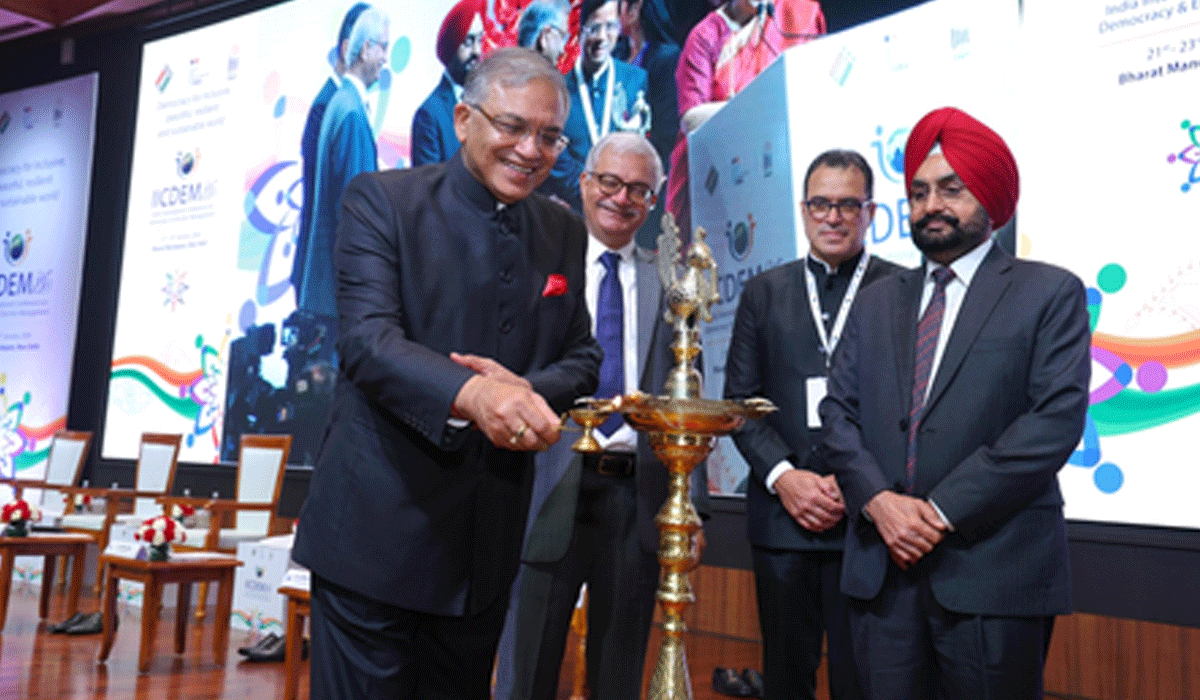
New Delhi: The Election Commission of India (ECI) on Wednesday commenced the India International Conference on Democracy and Election Management (IICDEM) 2026 at Bharat Mandapam in the national Capital.
The three-day conference is poised to be the largest global gathering of its kind hosted by India in the field of democracy and election management, bringing together election administrators, policymakers, academics, and experts from across the world.
Welcoming the delegates, Chief Election Commissioner (CEC) Gyanesh Kumar highlighted India’s ancient democratic system while addressing the delegates.
Earlier in the day, the ECI, led by Chief Election Commissioner (CEC) Gyanesh Kumar, along with Election Commissioners Dr. Sukhbir Singh Sandhu and Dr. Vivek Joshi, warmly welcomed esteemed dignitaries from more than 40 countries at the official reception for IICDEM 2026 held at Bharat Mandapam. The reception marked the formal start of deliberations and provided an opportunity for delegates to engage in dialogue on shared democratic values and electoral practices.
So far, approximately 71 delegates from 32 countries have arrived to participate in IICDEM 2026. The event is expected to be attended by nearly 100 international delegates from over 70 countries worldwide, along with representatives of international organisations, members of foreign Missions based in India, and academics and experts in election management.
The three-day programme includes a range of general and plenary sessions, beginning with the inaugural session, followed by plenary meetings of Election Management Body (EMB) leaders, EMB working group meetings, and thematic sessions. These discussions will focus on global electoral issues, model international electoral standards, as well as innovations and best practices in electoral processes, with the aim of strengthening democratic institutions worldwide.
Representatives from election management bodies across the globe will deliberate on ways to strengthen democracy, enhance voter participation, and make electoral processes more transparent, inclusive, and fair.
Addressing the gathering at the inaugural session, Chief Election Commissioner Gyanesh Kumar said, “Today, I stand before you to inaugurate this three-day international conference being held in New Delhi. First of all, I warmly welcome our international delegates. As we often say, India is the mother of democracy. When you step outside this hall, you will notice the stupa and the Ashokan pillar in the backdrop, which are popularly associated with the early foundations of democratic thought dating back to around 600 BCE.”
He further noted that the conference backdrop also featured a Sanskrit hymn from the Atharva Veda, dating back more than a millennium before the current era, which speaks about village samitis and committees.
“The backdrop also references Kudavolai, an ancient system of voting mentioned in Tamil inscriptions and sculptures dating to about a thousand years after the current era,” he said.
“All these historical pointers bring us together not only to celebrate democracy, but also to understand its future path, challenges, and ways to make electoral processes smoother and more efficient. They help us explain how Indian elections have become one of the largest democratic exercises on the planet, year after year, in terms of logistics, scale, and transparency,” the CEC added.
Highlighting the scale of Indian elections, Gyanesh Kumar said that in the last Lok Sabha elections, more than one billion voters were enrolled, over 640 million exercised their franchise, and polling was conducted at more than one million polling stations across the country.
“The Booth Level Officer is the foundation and the most important pillar of electoral democracy in India. As our Constitution provides, Indian elections are divided into two broad segments — the preparation of electoral rolls and the conduct of elections,” the CEC said.
Election Commissioner Vivek Joshi, in his address, welcomed the delegates to IICDEM 2026 and underscored the importance of robust electoral systems.
“Many of us here work with elections as part of our ongoing responsibilities. We know that elections are not merely events on a calendar; they are systems that require continuous preparation, coordination, and steady guidance,” he said.
He added that the Election Commission of India, a constitutional authority established under Article 324 of the Constitution of India, is entrusted with the responsibility of supervising, directing, and conducting elections. “Over the decades, the Commission has emerged as a cornerstone of India’s democratic framework, upholding the principles of neutrality, transparency, and fairness that are essential for free and fair elections,” Joshi said.


