
GHMC Launches 3-Day Joint Training for Metropolitan Surveillance Units in Hyderabad
GHMC has launched a three-day joint training programme for Metropolitan Surveillance Units from Hyderabad, Bengaluru and Thane to strengthen urban disease surveillance and public health response.

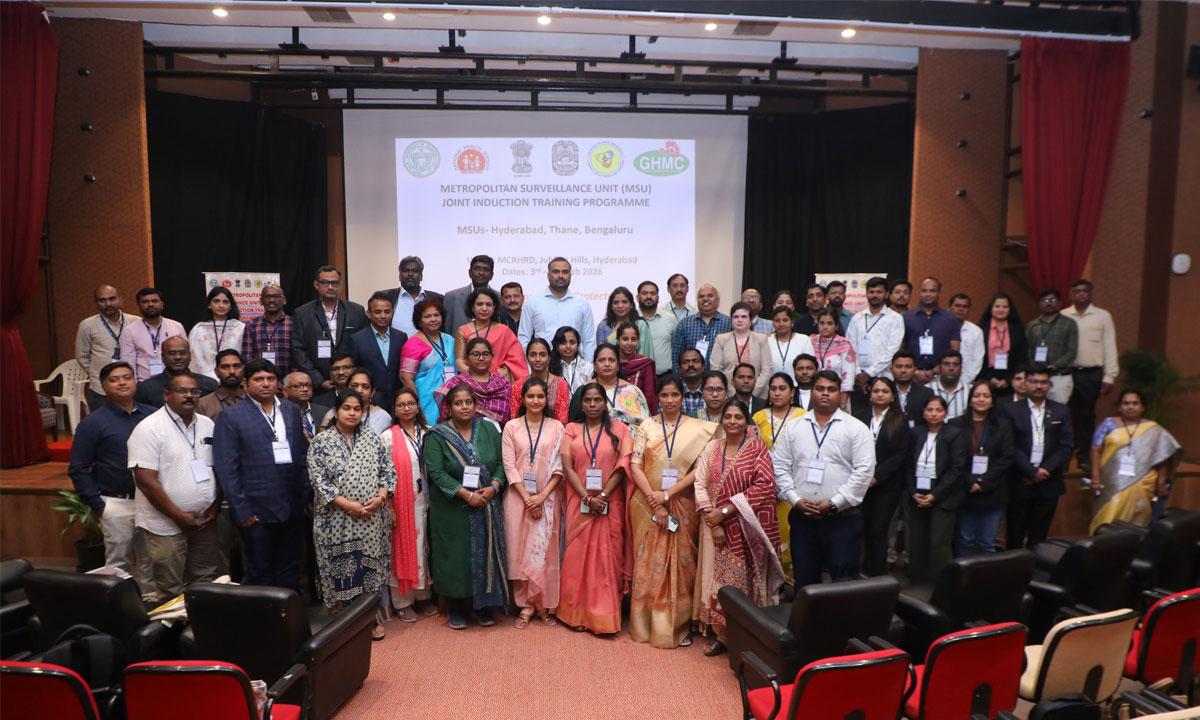
Hyderabad: The Greater Hyderabad Municipal Corporation (GHMC) has launched a three-day joint induction training programme for Metropolitan Surveillance Unit (MSU) staff from Hyderabad, Bengaluru, and Thane, aimed at strengthening urban disease surveillance and public health response systems.
Table of Contents
The training programme began on February 3 at the Dr. MCR Human Resource Development Institute (MCR HRD), Jubilee Hills, and will continue till February 5.
GHMC Commissioner Highlights Role of Surveillance Units
Addressing the participants, R. V. Karnan, Commissioner of Greater Hyderabad Municipal Corporation, said that Metropolitan Surveillance Units act as the frontline defence for public health in cities.
He stressed that the key responsibility of MSU staff is:
- Timely disease reporting
- Verification of health data
- Quick and effective response to outbreaks
Focus on High-Risk Diseases and Vulnerable Areas
The Commissioner said the training will focus on monitoring:
- Water-borne diseases such as Acute Diarrhoeal Diseases, Cholera, and Viral Hepatitis
- Vector-borne diseases like Dengue, Chikungunya, and Malaria
- Other public health threats including food poisoning and zoonotic diseases
Special attention will be given to slums, high-density areas, and migrant settlements, where the risk of disease spread is higher.
MSU Hyderabad Emerging as Key Surveillance Hub
Explaining the progress of MSU Hyderabad, Karnan said the unit was established under the Prime Minister–Ayushman Bharat Health Infrastructure Mission (PM-ABHIM) and is developing into a central hub for urban disease surveillance.
- Out of 17 sanctioned posts, 14 staff members have already been recruited
- Remaining vacancies will be filled soon
- Newly appointed staff are undergoing departmental orientation
Strengthening Labs and Command Control Systems
The Commissioner noted that:
- Laboratory services are operational at the Institute of Preventive Medicine (IPM), Narayanaguda
- Biosafety Level-II equipment is being added to strengthen lab capacity
- A Command Control Centre at Harihara Kala Bhavan is being set up to improve monitoring and rapid response
Use of Technology in Disease Monitoring
Hyderabad is using a dedicated Vector Borne Disease (VBD) application that supports:
- Real-time dengue surveillance
- GIS-based mapping
- Coordinated field response
This helps officials take data-driven public health decisions.
Training Modules and Collaboration
During the programme, participants will receive training on:
- Integrated Health Information Platform (IHIP)
- Real-time disease reporting using S, P, and L forms
- Event-based surveillance
- Epidemiological investigations and outbreak case studies
- Data security, risk communication, and community engagement
- Public health legal frameworks
Karnan emphasised that public health is a shared responsibility, involving departments such as health, water supply, sanitation, animal husbandry, and environmental management. He urged participants to use the training to build strong interdepartmental coordination and professional networks.
Several senior officials, including additional and zonal commissioners, public health experts, and medical officers, attended the programme.
Follow MunsifNews24x7 for latest updates.


