
Nepal polls largely peaceful as 24 per cent voter turnout recorded by 1 PM
Around 24 per cent of voters had cast their ballots by 1 pm on Thursday in Nepal’s parliamentary elections, with polling underway peacefully across the country, the country’s election body said.

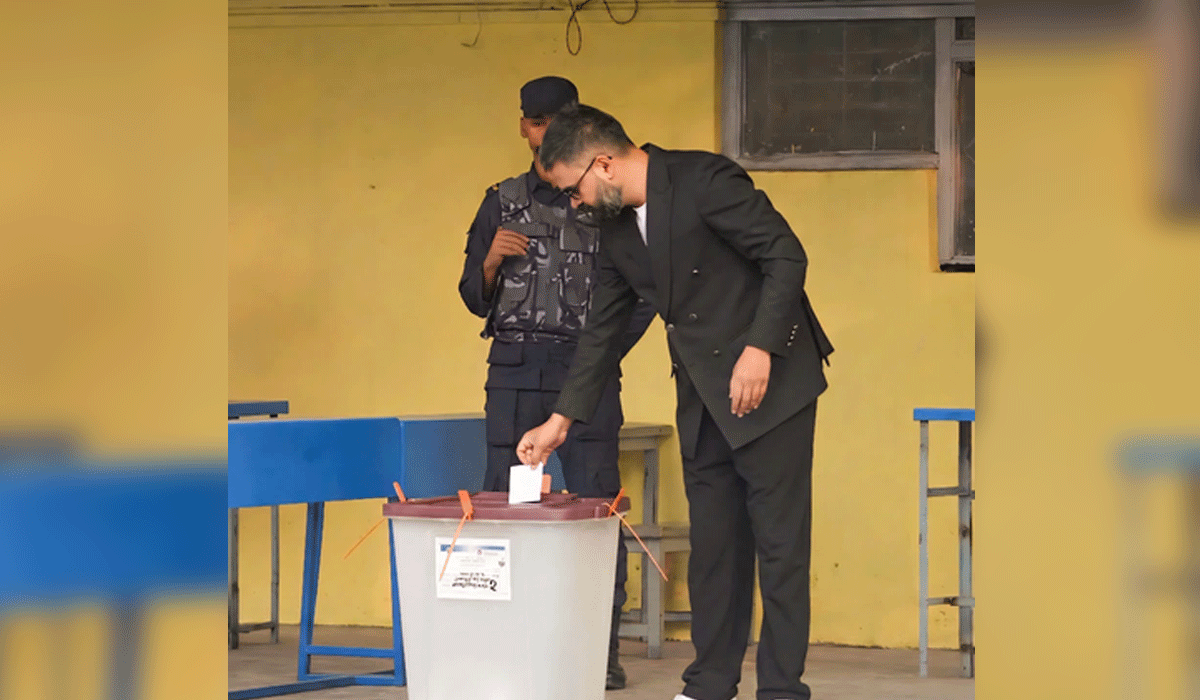
Kathmandu: Around 24 per cent of voters had cast their ballots by 1 pm on Thursday in Nepal’s parliamentary elections, with polling underway peacefully across the country, the country’s election body said.
More than 4.45 million voters had exercised their voting rights by 1 pm on Thursday since voting began at 7 am, accounting for 24 per cent of the total registered voters, the Election Commission said in its latest update.
More than 18.90 million people are eligible to vote in the elections, including 915,119 newly registered voters. It is the first election in the country since the Gen-Z revolt in September last year that ousted the government led by former Prime Minister K P Sharma Oli.
The polls are being held to elect 275 members of the House of Representatives, the lower house — 165 through the First Past-the-Post (FPTP) system and 110 through the proportional representation system.
Police said the polls were underway peacefully across the country until Thursday noon, with only sporadic minor incidents reported.
Deputy Inspector General Abi Narayan Kafle, spokesperson for Nepal Police, told IANS that polling was continuing smoothly except for minor incidents at a few polling centres, which had been brought under control.
“Essentially, the polls are being held in a very peaceful environment across the country so far,” he said, adding that no incident of violence had been reported until noon.
Voting was temporarily halted at a polling station in Tamakoshi Rural Municipality of Dolakha district in central Nepal after a representative of a candidate attempted to assault a polling officer when the officer refused to allow his request to vote by himself on behalf of others.
“Police fired a warning shot in the air to bring the situation under control,” Aulakh Bahadur Ale, Assistant Chief District Officer of Dolakha district, told IANS. “Voting has now been halted and an all-party meeting is underway to resolve the issue.”
Earlier in the morning, a minor scuffle was reported at a polling centre in the Sarlahi-4 constituency in southern Nepal. It is the constituency where Nepali Congress President Gagan Thapa is contesting the election, and his key rival is Amaresh Kumar Singh from the Rastriya Swatantra Party (RSP), who was also a lawmaker from the same constituency in the dissolved parliament.
No other incidents that could significantly affect the polls had been reported until Thursday noon, according to the police.
Prime Minister Sushila Karki and the country’s top leaders — including Nepali Congress President Gagan Thapa, Communist Party of Nepal (Unified Marxist-Leninist) Chairperson K P Sharma Oli, Nepali Communist Party Coordinator Pushpa Kamal Dahal ‘Prachanda,’ RSP President Rabi Lamichhane, and senior RSP leader and prime ministerial candidate Balen Shah — have already cast their votes.
After casting her vote, Prime Minister Karki urged voters to participate actively in the democratic process.
“I urge all voters to cast your valuable votes because voting will determine our future,” she said.
The elections are being held at 23,112 polling centres. A total of 3,406 candidates are contesting under the FPTP system, while 3,135 candidates are running under the proportional representation system.


