
CSIR Integrated Skill Initiative trains over 2 lakh workers in India
The CSIR Integrated Skill Initiative, a flagship national programme implemented by the Council of Scientific and Industrial Research (CSIR), has trained over 2 lakh workers across the country, the Ministry of Science & Technology said on Friday.

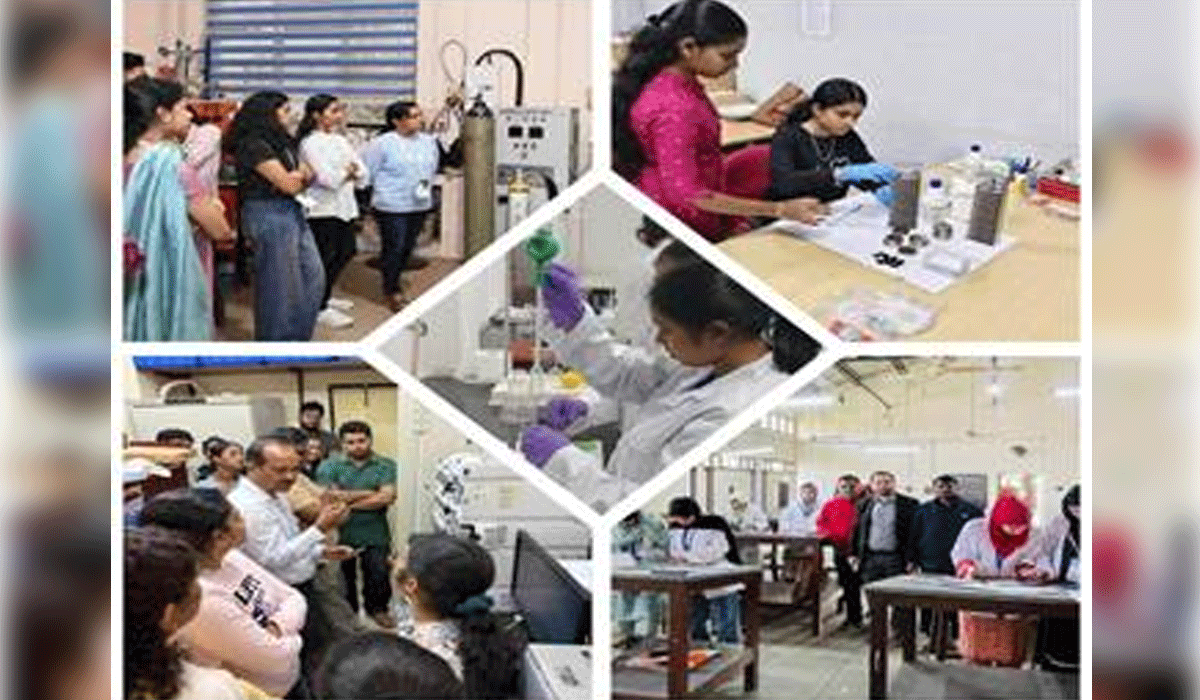
New Delhi: The CSIR Integrated Skill Initiative, a flagship national programme implemented by the Council of Scientific and Industrial Research (CSIR), has trained over 2 lakh workers across the country, the Ministry of Science & Technology said on Friday.
“During phase I and II of the Initiative, more than 1.90 lakh individuals were trained, through 5200+ skill-based trainings, including special targeted initiatives for rural citizens and women,” the Ministry said.
The third phase of the initiative was officially launched in June 2025 by Dr. N. Kalaiselvi, Director General, CSIR, and Secretary, DSIR, with a reinvigorated focus on advanced skilling, bridging academia-industry gaps, and accelerating development and growth.
“The first year of the third phase of this initiative has already trained more than 14,000 trainees by conducting 425+ training programmes across 37 CSIR laboratories, nationwide,” the Ministry said.
The CSIR Integrated Skill Initiative is closely aligned with the national vision of ‘Atmanirbhar Bharat’ and ‘Skill India’. It aims at bridging the gap between scientific research on one hand and industry requirements and employable skills on the other hand.
The programme provides inclusive accessibility, catering to a diverse spectrum of beneficiaries ranging from students, young researchers, technical staff, and working professionals to school dropouts, ITI diploma holders, farmers, and rural communities.
The primary emphasis of this initiative is to align skill training with real-world industrial, societal, and entrepreneurial demands.
The programme spans 18 out of 36 key sectoral skills as identified by the National Skill Development Mission (NSDM) which include aerospace and aviation, agriculture, automotive, construction, capital goods, electronics, food processing, green jobs, hydrocarbon, healthcare, handicrafts and carpets, iron and steel, rubber, chemicals and petrochemicals, leather, life sciences, management and entrepreneurship, mining, textile and IT and ITeS technologies.
The key goal of this initiative is to ensure learners acquire not only strong theoretical knowledge but also build practical competencies supporting employment, entrepreneurship, and overall career growth.


