
Guide young minds, control social media: Experts on states mulling ban on online presence of children
There is a debate blowing around reports that some states in India are mulling a ban on social media for children under 16 years of age, considering the effects it has on young minds.

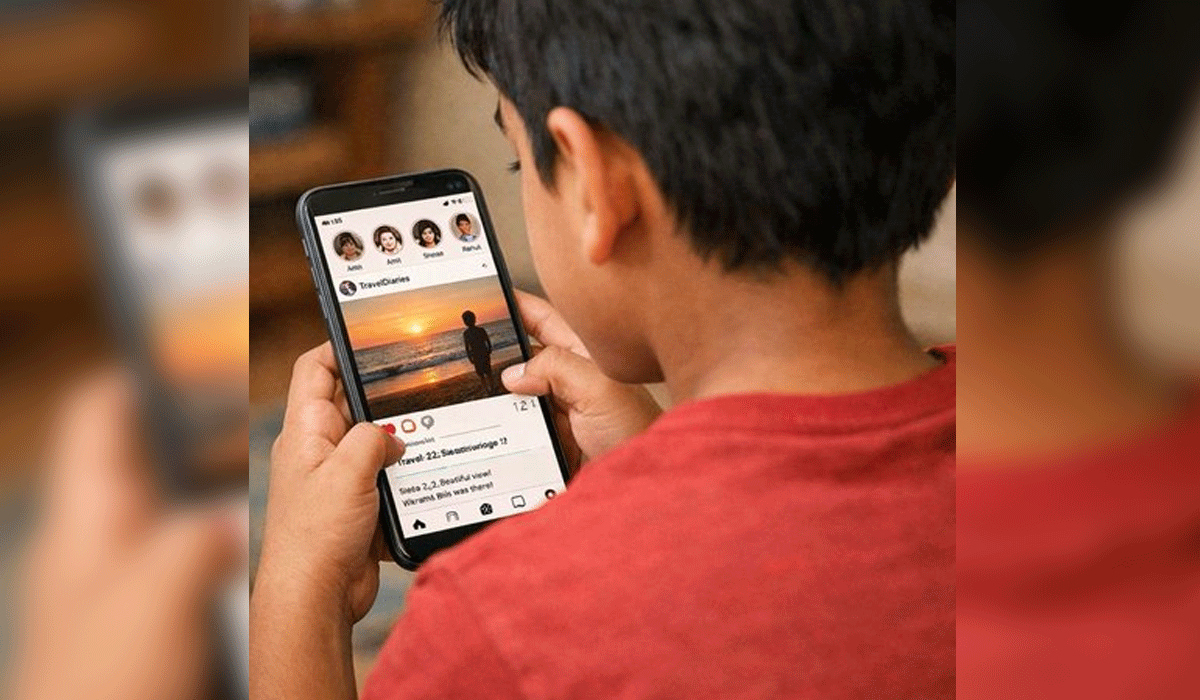
New Delhi: There is a debate blowing around reports that some states in India are mulling a ban on social media for children under 16 years of age, considering the effects it has on young minds.
In Australia, a law has been created to protect young people from features that encourage spending too much time on screens and show content that can be harmful to overall health and well-being, according to the country’s Office For Youth, which adds, “Restricting access aims to protect young people from these risks”.
Before rolling out the law they spoke with children and parents.
“Parents said that some children will somehow find out, but not all. It all depends how a legislation is introduced, how it’s monitored, and how the society and individual homes regulate it,” explained Jatin Gandhi, journalist, and a Trust and Safety practitioner.
Trust and Safety practices refer to policies, practices, and teams dedicated to ensuring that users can trust and feel safe while using online platforms and services.
“So, it’s definitely a step in the right direction. It has been ignored till now and social media had a free run and created havoc in our society. With Internet penetration rising fast and the decline in quality of online platforms as they prioritise profit over users, there’s a need for control,” he stressed.
“It’s dangerous to allow social media to permeate our lives; that’s why it is a good idea to first ban, then to regulate, then to ease,” he added.
Joydeep Dasgupta, an expert in fact checking, and media and AI literacy, shared cautious optimism.
“Social media use among children must be restricted. The Internet is a valuable resource for school assignments, where they should be allowed access with parental or teacher’s guidance,” he stated.
But, “The moment children are exposed to smartphones, they inevitably step into the digital world – and thereby, into social media. In today’s connected world, asking them to completely avoid smartphones or social networking platforms is neither practical nor realistic,” warned Sambit Pal, In-Charge Director at the International School of Broadcasting and Journalism at MIT Art, Design and Technology University in Pune.
“What we need instead is parental guidance and open conversations about how to use social media wisely. This is a far more effective way to minimise its harmful effects,” he too agreed.
According to Dasgupta, “Unrestricted social media access can expose children to online risks like cyberbullying, predators, and unhealthy comparisons. Parents should guide and set limits on screen time, ensuring a balance between digital learning and real-life interactions.”
Jatin Gandhi quoted Cory Doctorow to describe the predictable decline in quality of online platforms as they prioritise profit over users. He explained the three stages of social media, where in the first, it is perceived as being of value to society, empowering the individual, democratising communication, “so you build value for your user and you build a community and you lock in that community,” he explained.
“The platform grabs attention and then sells it to the advertiser. In the third stage, it doesn’t add value to either the end user or the business it had partnered with; but just amasses all the profits,” added Gandhi.
Doctorow is popular for his advocacy of liberalising copyright laws and for his work as a blogger and journalist, where he has covered topics such as digital rights management, file sharing, and post-scarcity economics.
“Earlier you searched for contents, now the content finds you,” stressed Gandhi on such platforms identifying user preference and targeting accordingly.
“Social media companies, too, must implement stricter age-verification systems and ensure that content offered to underage users is appropriate and safe,” added Dr. Pal.
“Without guidance or safeguards, children dive into an endless ocean of content without knowing how to swim through the waves. And if even adults often struggle to stay afloat, we can hardly expect children to manage it alone,” he said.


