
Hyderabad’s Regional Ring Road Scaled Down: Mega Project Turns into Standard Highway
The northern stretch of the RRR initially included plans for 204 bridges and culverts across rivers and streams such as Musi, Manjeera, and Haridra. However, due to high construction costs, the number of bridges has now been reduced by nearly half.

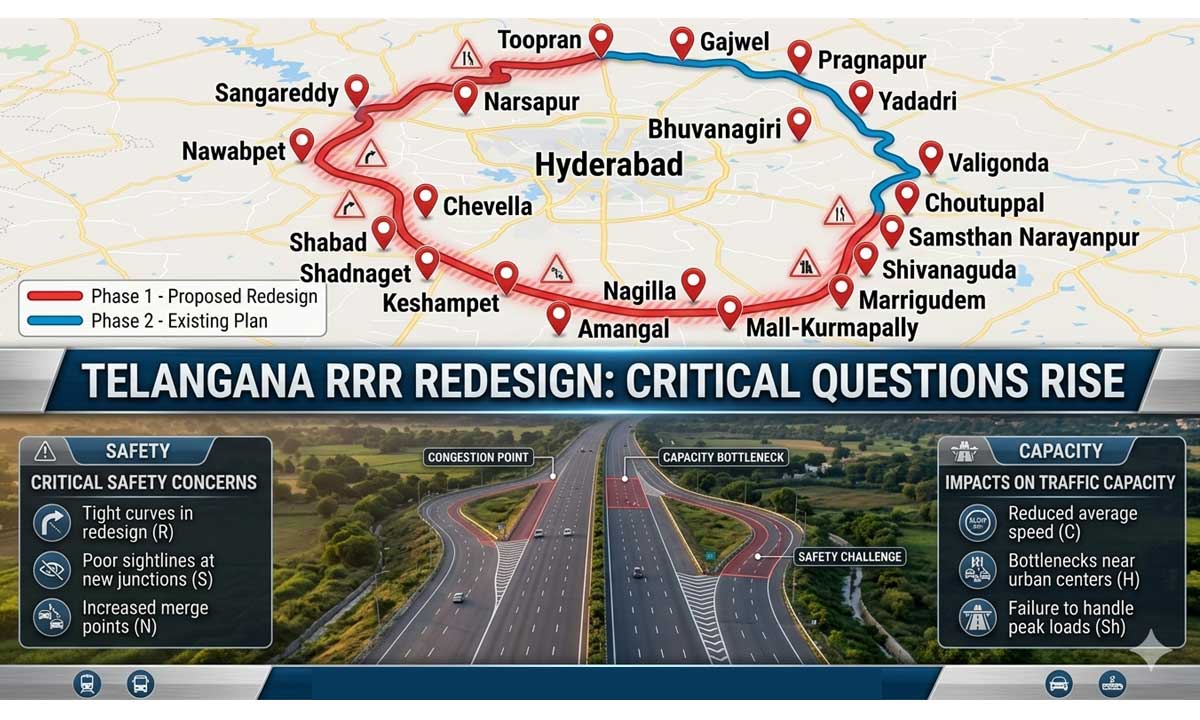
Hyderabad: In a significant shift, the ambitious Regional Ring Road (RRR) project planned around Hyderabad has undergone major design changes, effectively transforming it from a high-capacity express corridor into a standard national highway.
Originally envisioned as an 8-lane, high-speed ring road—one of the longest of its kind in the country—the project has now been reduced to a 6-lane highway following revisions by the Central and State governments. Officials stated that traffic projections for the next 20 years do not justify an 8-lane corridor, leading to the downsizing.
Table of Contents
Cost-Cutting Measures Alter Key Features
Several premium features initially planned for the RRR have been removed due to rising costs. The proposal to install continuous LED street lighting across the entire stretch has been dropped. Instead, lighting will now be limited to stretches passing through villages and habitations.
Similarly, the earlier plan to include service roads—like those along the Outer Ring Road—has been scrapped. The revised design provides only vacant buffer space along the highway, without even basic access roads in certain sections.
Reduced Speed and Safety Concerns
The maximum design speed of the highway has also been lowered. While the original plan allowed speeds of 120–130 km/h, the revised limit has now been capped at 100 km/h.
Safety-related design parameters have also been altered. The vertical curve design, which determines road visibility, has been reduced from 1300 meters to 650 meters. This change significantly lowers visibility distance—from about 600 meters to nearly 360 meters—raising concerns over potential accident risks, especially at higher speeds.
Bridges and Infrastructure Cut by Half
The northern stretch of the RRR initially included plans for 204 bridges and culverts across rivers and streams such as Musi, Manjeera, and Haridra. However, due to high construction costs, the number of bridges has now been reduced by nearly half.
Shift from Vision to Practicality
Experts believe that while the revised design may reduce the financial burden, it compromises the long-term capacity, safety, and efficiency of the project. What was once envisioned as a future-ready infrastructure project is now being viewed as a more conventional highway solution.
The changes have sparked discussions among urban planners and transport experts, who warn that scaling down such a critical infrastructure project could impact Hyderabad’s long-term growth and connectivity.


