
New political equations ahead of Assam Assembly poll a challenge to Opposition unity
Political parties opposed to the Bharatiya Janata Party (BJP) trying to consolidate vote banks for the 2026 Assembly polls are wary of the Jharkhand Mukti Morcha’s (JMM) apparent foray in the tribal-dominated constituencies.

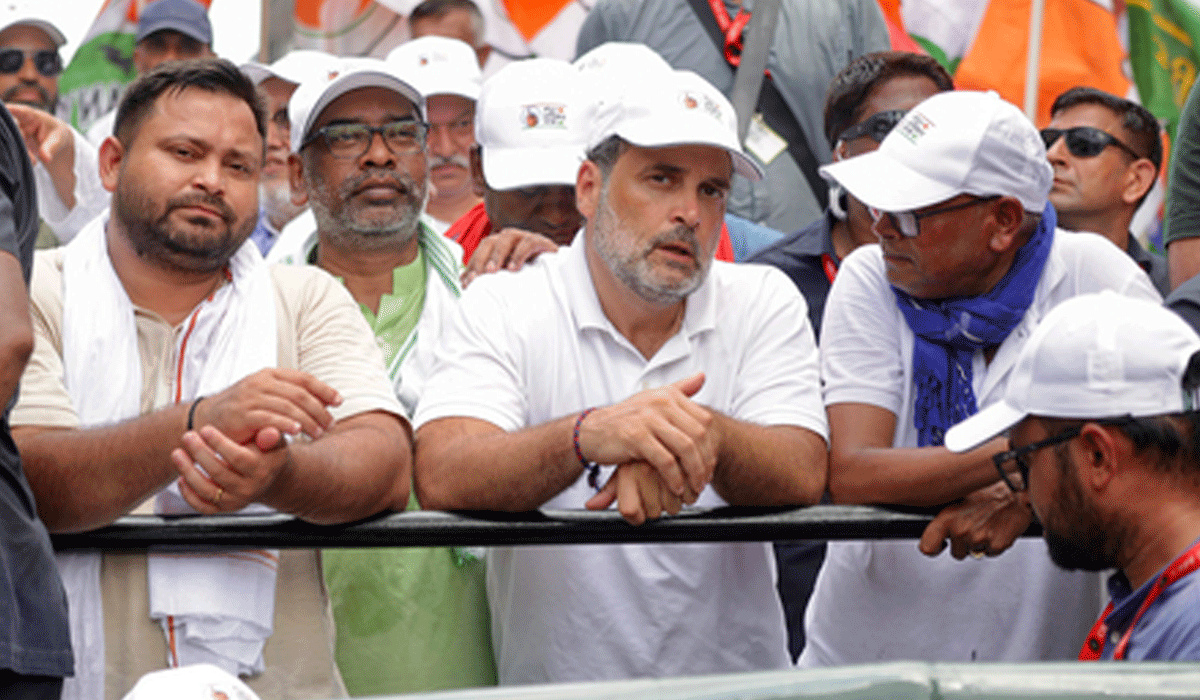
New Delhi: Political parties opposed to the Bharatiya Janata Party (BJP) trying to consolidate vote banks for the 2026 Assembly polls are wary of the Jharkhand Mukti Morcha’s (JMM) apparent foray in the tribal-dominated constituencies.
Added to their concerns is the silence of Badruddin Ajmal – the businessman heading All India United Democratic Front (AIUDF) – on a possible realignment with the Congress-led Mahajot for the 2026 Assam Assembly polls.
JMM, the principal constituent in Jharkhand’s ruling alliance, had given an indication in 2024 of expanding its footprints in selected seats in states like Assam and West Bengal, where elections are due next year. It also wanted to have leaders organise migrants from Jharkhand in other states, including Delhi, Madhya Pradesh, and Chhattisgarh.
Also Read: Bihar Dy CM Vijay Sinha hardens stand against land mafia, Revenue Dept feels impact
Working on its expansion plans, the party has already constituted a delegation which will visit Assam for an on-ground assessment. Political footprints beyond Jharkhand will give the party a scope to expand across tribal regions in other parts of the country, with a chance for being recognised as a national party.
In the Bihar election this year, the JMM sought to contest in alliance with the Opposition Mahagathbandhan bloc, but could not, despite the fact that the coalition is currently in power in Jharkhand. JMM was forced to withdraw from the race, much to the chagrin of its leaders, who indicated a review of the Jharkhand alliance. Though the alliance continues in office, there has been an uneasy calm since the Bihar episode.
The issue now risks fragmenting anti‑National Democratic Alliance (NDA) votes in key other states over internal clashes, potentially benefiting the BJP‑led platform, where unified seat allocation remains steadier.
Now, the JMM delegation’s report following its forthcoming Assam visit will give a clearer picture of the leadership’s future plans.
According to the Census of India, last held in 2011, Assam’s population stood at over 3 crore, with Scheduled Tribes accounting for almost 39 lakhs, or 12.4 per cent of the total. The tribal population in Assam was predominantly rural, with 94.4 per cent residing in such areas. The major tribes include Bodo, Mishing, Karbi, Rabha, SonowalKachari, Lalung, Garo, and Dimasa.
Of the 126 seats in the Assam Legislative Assembly, 19 are reserved for Scheduled Tribes, as are two of its 14 Parliament Constituencies. Tribal issues are sensitive, and clashes have been reported with settlers, considered outsiders.
There have been violent incidents in Lower Assam between Bodo and Bengali-speaking Muslims. Currently, Karbi Anglong is on the edge with news of skirmishes between the local Karbi tribal population and non-Karbi, as Bihari communities settled there.
Incidentally, Assam’s tribal politics is already dominated by regional parties and autonomous council-based groups, where the JMM may have to negotiate with regional leaders. In the process, the state’s principal Opposition Congress party stands to lose ground.
The United People’s Party Liberal (UPPL), which has held its sway in the Bodoland Territorial Region, won six of the 11 seats it contested as part of the NDA in the 2021 Assembly elections.
Meanwhile, Bodoland People’s Front (BOPF), a former NDA ally, later joined the Congress-led alliance Mahajot to win four of the 12 seats it contested in the last Assembly polls. While the JMM stands to upset the Congress in pockets, Ajmal’s stand further creates questions over Mahajot. Instead, he has alternated between contemplating going solo and entering an understanding with the All India Majlis-e-Ittehadul Muslimeen (AIMIM), which has unsettled Congress.
Historically, AIUDF and Congress have collaborated in minority-dominated constituencies in Lower Assam and Barak Valley, but the alliance has been inconsistent, with Congress often wary of Ajmal’s influence. Some reports speculate a seat understanding with the Hyderabad-based AIMIM, led by Asaduddin Owaisi, without entering into a formal agreement. The AIUDF – strong in Muslim-majority areas like Lower Assam, Barak Valley, among other pockets – won 16 of the 20 seats it contested the last time.
The Congress itself managed to score victories in 29 of the 95 seats it contested, while the Mahajot overall got 50 seats, increasing its tally from 26 in 2016.
Meanwhile, the BJP, with 60 seats, went on to form the government in 2021, retaining power for the NDA (total 75 seats), and marking a first for a non-Congress coalition to win a second-consecutive term in the state.
The Asom Gana Parishad (AGP), a regional ally of the BJP rooted in Assamese nationalism, got nine seats. The last state poll was dominated by the BJP and Congress, but regional and minority-focused parties like the AIUDF, AGP, UPPL, BPF, etc played crucial roles in coalition-building and influencing outcomes in tribal and minority regions.


