
Smog blankets Delhi as AQI turns very poor again, Jahangirpuri crosses 400-mark
Delhi woke up to a dense blanket of smog on Friday, with the overall Air Quality Index (AQI) reaching 331 at 7 a.m., placing the city once again in the 'very poor' category, according to the Central Pollution Control Board (CPCB). Jahangirpuri emerged as the worst-affected locality in the national capital with an AQI of 405, pushing it into the 'severe' zone.

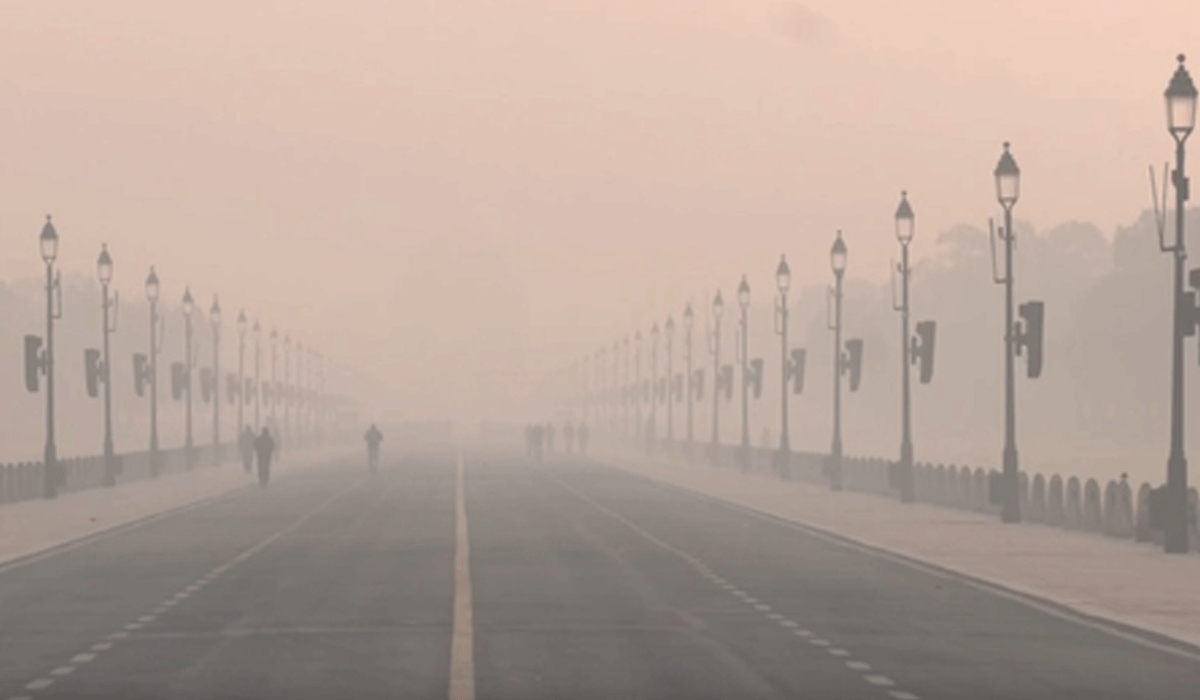
New Delhi: Delhi woke up to a dense blanket of smog on Friday, with the overall Air Quality Index (AQI) reaching 331 at 7 a.m., placing the city once again in the ‘very poor’ category, according to the Central Pollution Control Board (CPCB). Jahangirpuri emerged as the worst-affected locality in the national capital with an AQI of 405, pushing it into the ‘severe’ zone.
The smog and shallow fog significantly reduced visibility across the national capital. Anand Vihar recorded an AQI of 395, while other pollution hotspots included Vivek Vihar at 393, Ashok Vihar at 382, Bawana at 373, NSIT Dwarka at 388, Rohini at 385, Wazirpur at 397, Chandni Chowk at 368, and DTU at 371.
Also Read: Mamata Banerjee submitted her enumeration form, misleading people on SIR, says BJP
Despite marginal improvement in recent weeks, large parts of Delhi remained engulfed in toxic haze. Thick smog was reported in areas such as Ghazipur and Anand Vihar, making morning commuting difficult. Sonia Vihar recorded an AQI of 346, while Wazirpur touched 397 and Dhaula Kuan logged 337.
Neighbouring cities also continued to suffer from deteriorating air quality. Noida’s Sector 116 touched the 400 mark, with the city’s average AQI at 360. Greater Noida recorded an AQI of 342. In Uttar Pradesh, Meerut averaged 374 across three monitoring stations, while Loni in Ghaziabad reached a hazardous 427.
The India Meteorological Department (IMD) forecast partly cloudy skies with shallow to moderate fog on Friday morning. Minimum temperatures in Delhi are expected to remain between 7 and 9 degrees Celsius, while daytime temperatures may hover between 23 and 25 degrees Celsius, aligning with seasonal norms.
Earlier, Delhi Chief Minister Rekha Gupta assured residents that the government is taking action on all fronts to curb pollution in the national capital. She reiterated that the fight against pollution is progressing in “continuous mission mode”. Speaking to reporters, Gupta said that work to install mist-spraying systems on electric poles across the city is underway to help reduce particulate matter.
“Our fight against pollution in Delhi continues non-stop in mission mode. Smoke, dust, vehicle emissions, open garbage burning and wood burning — these factors together create a layer of pollution in the air. The Delhi government is working on each element that contributes to pollution. In Delhi, work to install mist at electric poles is ongoing. To stop pollution, the government is active on every front,” CM Gupta said.
Delhi had been on a three-day streak of poor air quality, with Thursday’s AQI at 285, marginally below the “very poor” threshold of 301.
The CPCB categorises AQI levels as follows: 0-50 “good”, 51-100 “satisfactory”, 101-200 “moderate”, 201-300 “poor”, 301-400 “very poor”, and 401-500 “severe”.
The IMD added that minimum temperatures across northwest India, including Delhi and its surrounding NCR regions, are expected to remain steady for the next two days before rising by 2 to 4 degrees Celsius over the subsequent three days.


