
Army Chief General Upendra Dwivedi calls for expanding ‘Smart Power’ in volatile world
Pointing to the turmoil in the Strait of Hormuz, Indian Army Chief General Upendra Dwivedi on Tuesday led discussions on how the country can integrate military, diplomatic, economic and technological instruments to expand its “Smart Power” to navigate an increasingly volatile global environment.

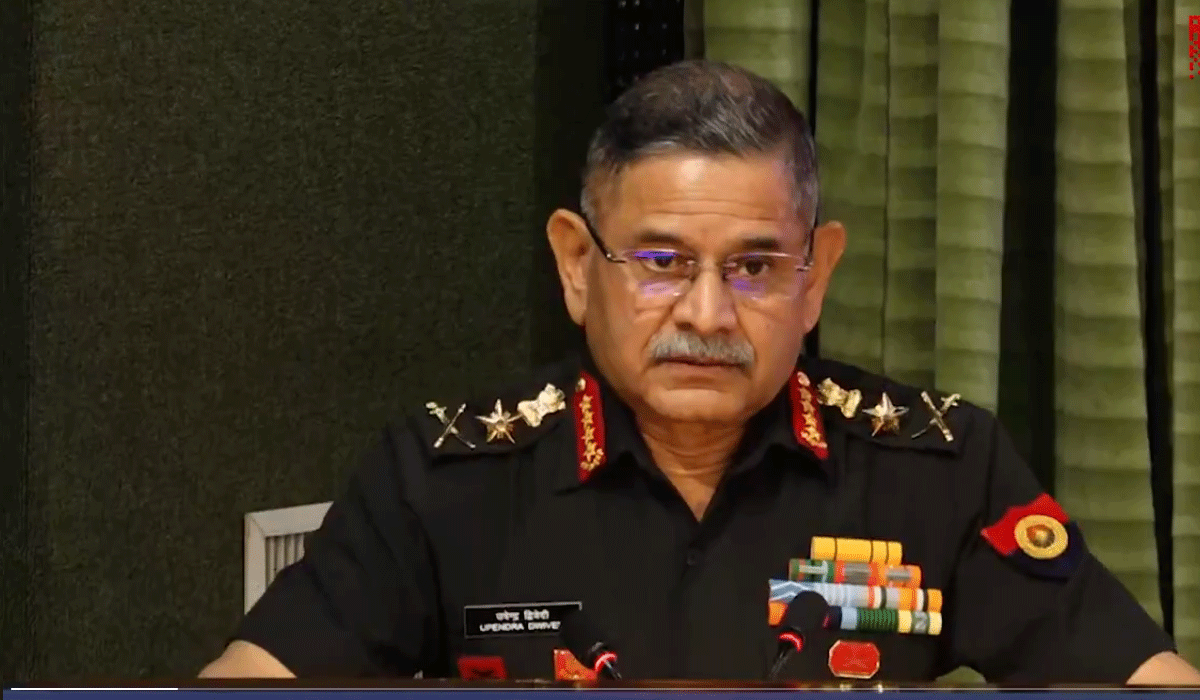

New Delhi: Pointing to the turmoil in the Strait of Hormuz, Indian Army Chief General Upendra Dwivedi on Tuesday led discussions on how the country can integrate military, diplomatic, economic and technological instruments to expand its “Smart Power” to navigate an increasingly volatile global environment.
Speaking at a National Seminar on “Security to Prosperity: Smart Power for Sustained National Growth,” General Dwivedi shed light on forces of trade becoming tools of strategic leverage.
“Semiconductors and their selective availability have become tools of strategic leverage. The Strait of Hormuz has become a zone of active contestation,” he said.
Highlighting that the boundary between security and prosperity is no longer a boundary at all, he said the vision of collective progress has been overshadowed by other matters of national interest and stressed on expanding the nation’s “Smart Power” in the fractured, fast-moving and unforgiving world.
Elaborating on the possible architecture of India’s “Smart Power” in today’s world, he quoted experts who have described it as the strategic intelligence to know which instrument to deploy at what intensity and towards what end.
“For India, it means using national strength with strategic wisdom to secure peace, accelerate growth and shape the global environment in our favour,” said the Army Chief.
General Dwivedi said there is a need for the traditional strategic framework of DIME – Diplomatic, Informational, Military and Economic elements – to be supplemented with new elements like technology and a “whole of nation” approach.
“The raw calculus of hard power has once again reclaimed the centre stage of the global order. But to respond to it, we must first read the world as it is, not as we wish it to be. The 21st century began with a confident belief that forces of trade, supply chains, and digital connectivity would make nations too interdependent for conflict. Paradoxically, the same forces that were expected to bind nations together have progressively become instruments of coercion,” he said.
General Dwivedi said contemporary conflicts impose sustained demands not only on armed forces but on industrial production, research systems and governance structures.
“Security is no longer a cause that prosperity must bear. It is the precondition for prosperity to commence its progressive journey,” he said, describing the umbrella of hard power as the new normal.


