
Supreme Court issues notice on plea against HC order quashing protest case against Bhagwant Mann
Appearing for the Chandigarh Administration, Additional Solicitor General S.V. Raju argued that the High Court had erred in holding that no unlawful assembly existed merely because there was no prohibitory order under Section 144 of the Code of Criminal Procedure (CrPC).

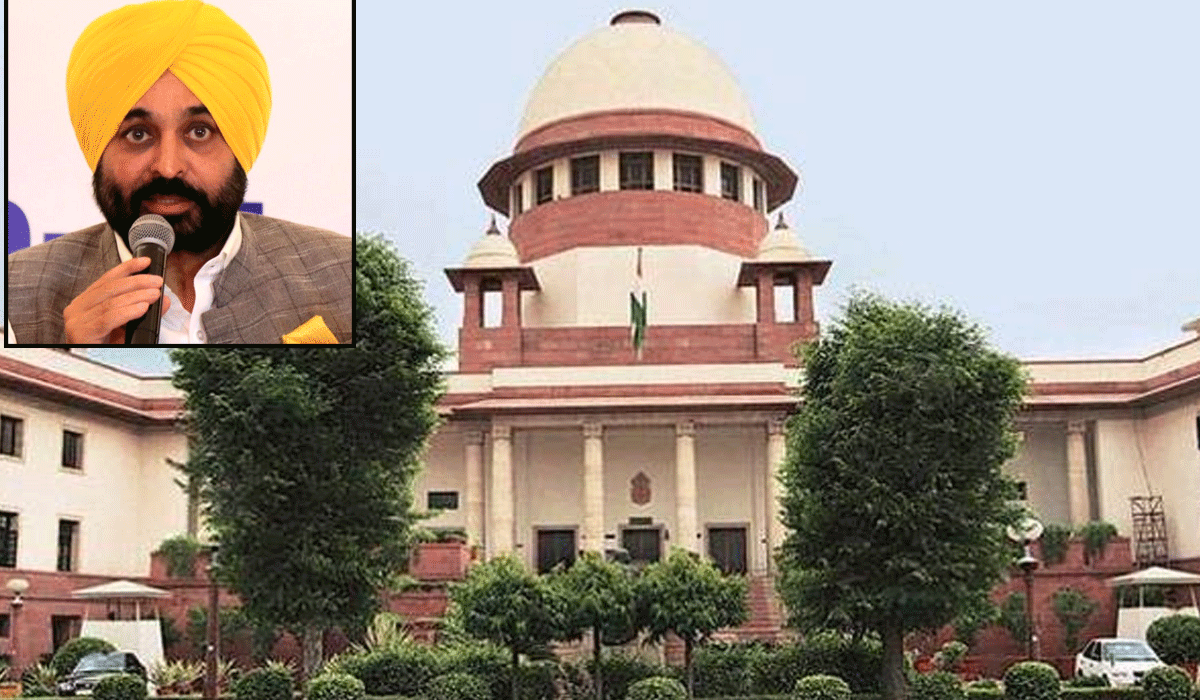

New Delhi: The Supreme Court on Thursday issued notice on a plea filed by the Union Territory of Chandigarh challenging the Punjab and Haryana High Court order that quashed criminal proceedings against Punjab Chief Minister Bhagwant Mann and other Aam Aadmi Party (AAP) leaders in a case arising from a protest in 2020 that allegedly turned violent and left police personnel injured.
A Bench of Chief Justice of India (CJI) Surya Kant and Justices Joymalya Bagchi and V. Mohana passed the order while hearing a special leave petition (SLP) filed by the Chandigarh administration against the High Court judgment in favour of Mann, Aman Arora, Daljit Singh Cheema and Maheshinder Singh Grewal.
Appearing for the Chandigarh Administration, Additional Solicitor General S.V. Raju argued that the High Court had erred in holding that no unlawful assembly existed merely because there was no prohibitory order under Section 144 of the Code of Criminal Procedure (CrPC).
“Unlawful assembly was admittedly there. The accused were present. Named in the FIR. Unlawful assembly indulged in violence; injuries caused to police officers. Prima facie offence made out,” ASG Raju submitted.
The Centre’s law officer further argued that even if an accused had not committed any overt act, acts committed by a member of an unlawful assembly could attract liability under Section 149 of the Indian Penal Code (IPC).
“Even if he was not involved in an overt act, any act by a member of the assembly is attributable to him,” ASG Raju submitted.
After hearing the submissions, the apex court issued notice in the matter.
According to the computerised case status available on the Supreme Court website, the SLP is tentatively likely to be listed next on September 18.
The case arises out of an FIR registered at Police Station North Sector 3, Chandigarh, in connection with a January 10, 2020 protest by AAP workers and leaders near the residence of the then Punjab Chief Minister.
The FIR invoked Sections 147, 149, 332 and 353 of the IPC, while the offence under Section 188 IPC was subsequently deleted.
According to the prosecution case, around 750-800 AAP workers had gathered during a protest against the hike in electricity tariffs. The police claimed that after being stopped from proceeding towards the Punjab Chief Minister’s residence, protesters pushed police personnel, attempted to breach barricades and later pelted stones, causing injuries to officials on duty.
However, the Punjab and Haryana High Court, in its judgment delivered on November 29, 2025, allowed the petitions filed by Mann and the other accused and quashed the FIR and consequential proceedings against them.
A single-judge Bench of Justice Tribhuvan Dahiya held that there was no order under Section 144 Cr.P.C. in force at the relevant time and, therefore, the assembly could not be termed unlawful merely on that basis.
It held that no specific overt act, including stone-pelting or any particular act of assault, had been attributed to the petitioners.
The High Court observed that “nobody has been named from amongst the persons present who allegedly pelted stones on the police force” and that “there is no basis to ascribe the alleged act of throwing stones by the mob to the petitioners”.
It further recorded that “no act, voluntary or otherwise, has been attributed to the petitioners” and that the alleged injuries appeared to have resulted from “grappling and pushing” during the protest.
The High Court also held that the prosecution’s own case did not establish the existence of an unlawful assembly, observing that no prohibitory order under Section 144 CrPC had been issued.
It ruled that since unlawful assembly is the sine qua non for offences under Sections 146 and 149 IPC, “ingredients of none of the offences alleged can be said to have been made out against any of the petitioners even prima facie”.


