
Granted international validation, Pak military regime intensifies aggression against Afghanistan
Pakistan’s military establishment behaves not simply as a “State sponsor of proxies”, but as a proxy force backed by its own state apparatus — using civilian governments as diplomatic packaging while the army maintains strategic control.

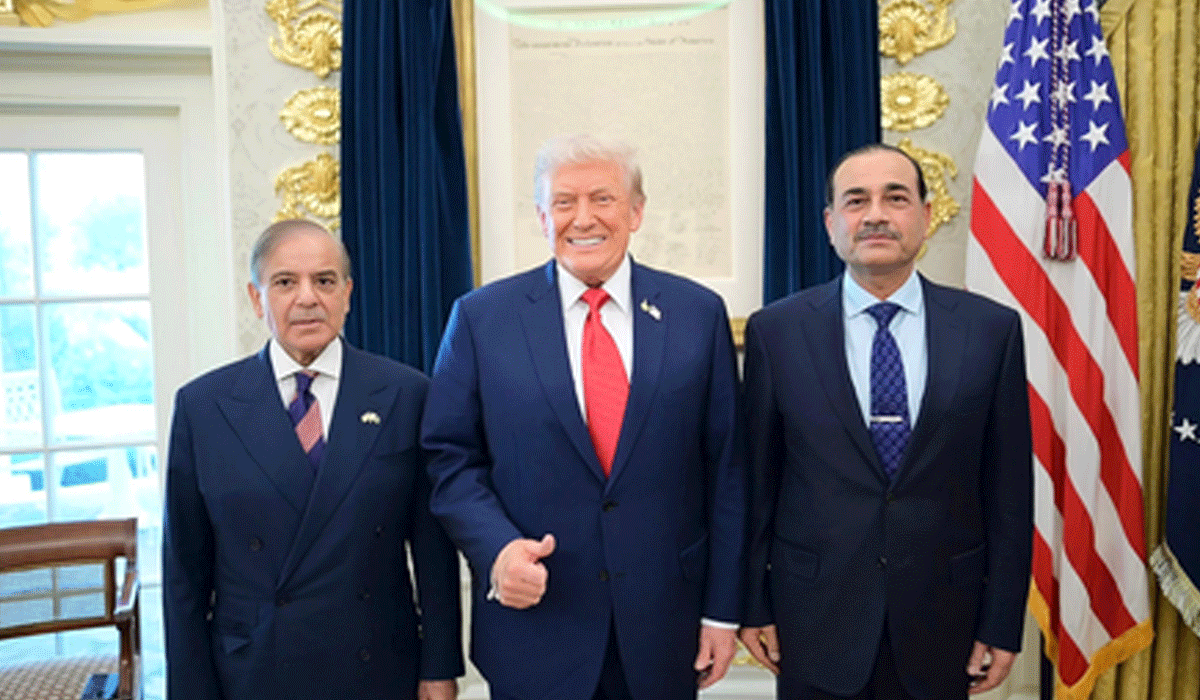
Islamabad: Pakistan’s military establishment behaves not simply as a “State sponsor of proxies”, but as a proxy force backed by its own state apparatus — using civilian governments as diplomatic packaging while the army maintains strategic control.
When granted international validation, the military regime translates that legitimacy into operational freedom — intensifying coercion against Afghanistan, violating its sovereignty, and causing recurring civilian casualties documented by global media outlets and organisations, including the United Nations, a report detailed.
“Pakistan’s military establishment has spent decades turning Afghanistan into a managed battlefield — an arena to be penetrated, pressured, and periodically punished so that no Afghan government can fully control its sovereignty or pursue an independent regional policy. That doctrine is usually packaged in the language of ‘strategic depth,’ ‘counterterrorism’, or ‘Line of Control (LOC)/Durand Line security’,” a report in ‘Eurasia Review’ detailed.
“In practice, it has looked like a repeatable cycle: build proxies, weaponise instability, sell ‘solutions’ to outside powers, and then reset the crisis whenever Afghanistan begins to slip outside Pakistan’s control,” it added.
According to the report, the recent escalations — marked airstrikes, drone attacks, and cross-border violence — reflect this pattern.
“What makes the latest phase distinct”, it said, is the “recurring pattern of Washington validation followed by Afghan bloodshed” – moments when Pakistani Prime Minister Shehbaz Sharif and “self-declared” Field Marshal Syed Asim Munir are publicly praised by President Donald Trump, “followed soon after by Pakistani attacks inside Afghanistan that Afghans and UN-linked reporting describe as involving civilian casualties.”
“Timing alone does not prove causation. But when timing repeats in the same political rhythm — praise, photo-ops, diplomatic uplift; then bombs over Afghan territory — it becomes a pattern that deserves documentation, not dismissal,” the report noted.
According to the report, Pakistan’s military leadership does not require an explicit written “green light” to act, arguing that global politics often functions through signals such as “who is welcomed, who is praised, who is treated as indispensable, and who is publicly framed as a ‘partner’.”
When Pakistan’s top military leadership receives strong validation in Washington — particularly during heightened regional tensions — Rawalpindi may interpret it as diplomatic cover to act more aggressively against Afghanistan while still projecting itself as a cooperative partner.
The report further said, “Trump’s public praise of Sharif and Munir is not only symbolism; it shapes the narrative environment. It positions Pakistan as a valued partner while Afghanistan is framed primarily as a source of militancy and disorder. That asymmetry — praise for Islamabad, suspicion toward Kabul — makes it easier for Pakistan to violate Afghan sovereignty, kill civilians and still claim legitimacy as a counter-terror actor.”


