
Air Conditioners in India: Protection from Extreme Heat or Growing Threat to the Planet?
India is witnessing rising heatwaves and increasing dependence on air conditioners as temperatures touch 45°C in several states. Experts warn that growing AC use may worsen climate change and environmental damage.

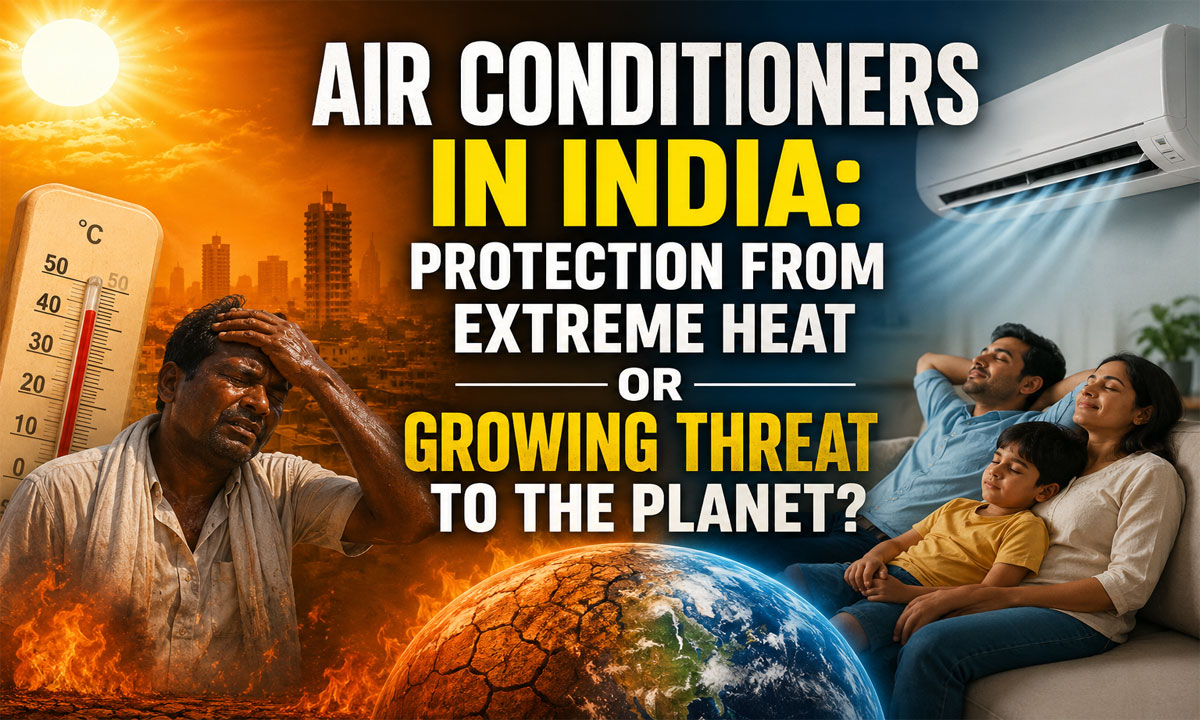

India is facing a major climate challenge as rising temperatures and severe heatwaves are forcing millions of people to depend on air conditioners for survival, while the growing use of ACs is also increasing environmental risks. Across several Indian states, temperatures have already reached 43 to 45 degrees Celsius even before the peak summer season of 2026, raising concerns about climate change, urban heat, rising electricity demand, and carbon emissions.
India Faces Rising Heatwave Crisis in 2026
India is currently standing at a critical crossroads where there is an urgent need to protect human lives from extreme heat, while the same protective measures are worsening the environmental crisis.
Air conditioners are no longer considered a luxury item in India. In a hot country like India, they are increasingly becoming the difference between life and death for millions of people. However, this growing dependence on ACs reflects a major environmental and social contradiction. The same machines that provide relief from heat are also contributing to global warming.
Even before the full arrival of summer in 2026, several parts of India started experiencing extreme temperatures. By mid-April, temperatures in Madhya Pradesh, Maharashtra, Odisha, and Chhattisgarh had already reached between 43 and 45 degrees Celsius.
The India Meteorological Department warned that eastern, central, and northwestern India could experience severe heatwaves in the coming months. Experts say this is not merely a seasonal change but a serious sign of the climate crisis.
India’s Average Temperature Has Increased Since 1901
India has always had a warm climate, but the intensity and duration of heat have increased significantly in recent decades.
According to the India Meteorological Department (IMD), India’s average annual temperature increased by around 0.9 degrees Celsius between 1901 and 2024. While this rise may appear small, climate scientists warn that even a one-degree increase can significantly alter global environmental systems.
The year 2024 was declared the hottest year on record globally and in India. Nearly every month during the year recorded above-normal temperatures.
The effects are being directly felt on human lives, the economy, agriculture, water supply, and public health. Extreme heat in India is making it difficult for poor laborers, auto-rickshaw drivers, construction workers, farmers, and factory workers to continue working during afternoon hours.
Urban Heat Island Effect Making Indian Cities Hotter
The situation in Indian cities is becoming more severe due to the “urban heat island” effect. Concrete and cement-filled cities are recording temperatures several degrees higher than nearby rural areas.
A lack of trees, vehicle pollution, industrial activities, and rapidly increasing population are worsening the crisis further.
Air conditioners were once considered products only for the wealthy in India, but the situation has changed. Severe heat is now forcing middle-class families to purchase ACs as well.
Sales of air conditioners in urban India are increasing rapidly every year, and estimates suggest India could become the world’s largest cooling market over the next two decades.
Why Air Conditioners Are Becoming Essential in India
The growing demand for cooling is linked to a basic human need — survival.
When temperatures cross 45 degrees Celsius, the human body struggles to cool itself naturally. This leads to an increase in heatstroke, dehydration, heart-related illnesses, and respiratory problems. Elderly people, children, and sick individuals are the most vulnerable.
In such conditions, air conditioners no longer feel like a luxury but a necessity for survival. Demand for cooling systems is rising in hospitals, schools, offices, metro stations, and homes across India.
However, this increasing demand is also creating another environmental crisis.
How Air Conditioners Harm the Environment
Air conditioners damage the environment mainly in two ways:
Massive Electricity Consumption
Air conditioners require huge amounts of electricity to operate. In India, a major portion of electricity is still generated using coal.
When millions of ACs run simultaneously, pressure on power plants increases, leading to more coal consumption. Burning coal releases carbon dioxide, which is one of the main causes of global warming.
Release of Refrigerant Gases
Certain gases used in air conditioners are highly dangerous for the environment.
If these refrigerant gases leak into the atmosphere, their greenhouse effect can be thousands of times more powerful than carbon dioxide. Although older harmful gases are being phased out worldwide, many refrigerants still remain a major environmental threat.
Cooling Crisis Also Linked to Social Inequality
India’s cooling crisis is not only an environmental issue but also a matter of social justice.
Wealthy people can protect themselves from heat inside air-conditioned homes, offices, and vehicles, while poor communities continue to suffer directly under extreme temperatures.
Millions of people living in slums do not have proper housing, stable electricity supply, or cooling facilities. Tin-roof houses become unbearably hot during summer nights, making sleep difficult for many families.
Extreme heat is also affecting children’s education, mental health, and overall well-being.
Poor Urban Planning Increasing Heat in Indian Cities
Unplanned urban growth has intensified India’s heat problem.
Green spaces in cities are shrinking, while lakes and ponds are disappearing. Tall buildings and roads absorb heat during the day and continue releasing it throughout the night.
Trees naturally act as air conditioners, but millions of trees have been cut down in the name of urban expansion.
Experts believe better urban planning could significantly reduce heat levels in Indian cities.
Rural India Also Facing Severe Heat Impact
The heat crisis is not limited to urban areas.
Farmers in rural India are facing changing rainfall patterns, droughts, and heatwaves that are damaging crops. Laborers continue working under open skies where temperatures often become life-threatening.
Electricity supply in rural areas also remains unstable, making air conditioners and coolers inaccessible for many families.
As a result, rural populations remain more vulnerable to extreme heat.
Heat Becoming a Silent Killer in India
Extreme heat is increasingly becoming a silent killer in India.
Every year, thousands of people suffer from heatstroke and heat-related illnesses. Many deaths are never officially recorded.
India is rapidly expanding solar and wind energy production. Experts believe that if the rising demand for air conditioners is met using clean energy, environmental damage can be reduced.
Solar energy is considered especially promising because hotter days also produce stronger sunlight, meaning solar power generation increases at the same time when AC demand rises.
Installing solar panels on homes and buildings could reduce pressure on the electricity system, though this would require large-scale investment, modern infrastructure, and policy reforms.
Traditional Indian Architecture Offers Natural Cooling Solutions
Traditional Indian architecture once included several natural cooling methods.
Unlike modern concrete buildings, older Indian homes often had thick walls, high ceilings, courtyards, ventilated windows, and airflow systems that kept homes naturally cooler.
The havelis of Rajasthan, traditional homes in South India, and Mughal architecture are examples of climate-friendly construction designed according to local weather conditions.
Experts say modern urban planning should revive these traditional principles.
India’s Future Depends on Sustainable Cooling Solutions
India is expected to become the world’s most populous and one of the fastest-growing countries in the coming years. With this growth, demand for cooling systems is expected to rise sharply.
If current trends continue, electricity consumption and carbon emissions could reach dangerous levels.
At the same time, this crisis also presents an opportunity. If India invests in sustainable cooling, clean energy, and environmentally friendly urban planning, it could become a global example.
The country now faces a major choice — whether to continue depending on cooling systems that provide temporary relief while worsening climate change, or to build a future where both people and nature can survive safely.
India’s growing dependence on air conditioners reflects one of the biggest modern challenges: balancing development, comfort, and environmental protection. Rising heatwaves have made cooling essential for survival, but the current system is also deepening the climate crisis.
This issue cannot be solved through technology alone. It will require collective awareness, better government policies, social justice, sustainable lifestyles, clean energy investment, and climate-sensitive urban planning.
If timely action is not taken, extreme heat in India may soon become not just a seasonal issue but one of the biggest threats to human survival. India is currently standing at a historic turning point, where the choices made today will determine whether future generations inherit a livable planet or a dangerously overheated world.
Follow MunsifNews24x7 for latest updates.


