
MEIL Achieves Historic Breakthrough in Zojila Tunnel, Bringing Kashmir-Ladakh All-Weather Connectivity Closer to Reality
The project has also achieved a significant safety milestone of 10 million safe man-hours, reflecting MEIL's commitment to maintaining the highest standards of safety and quality during construction.

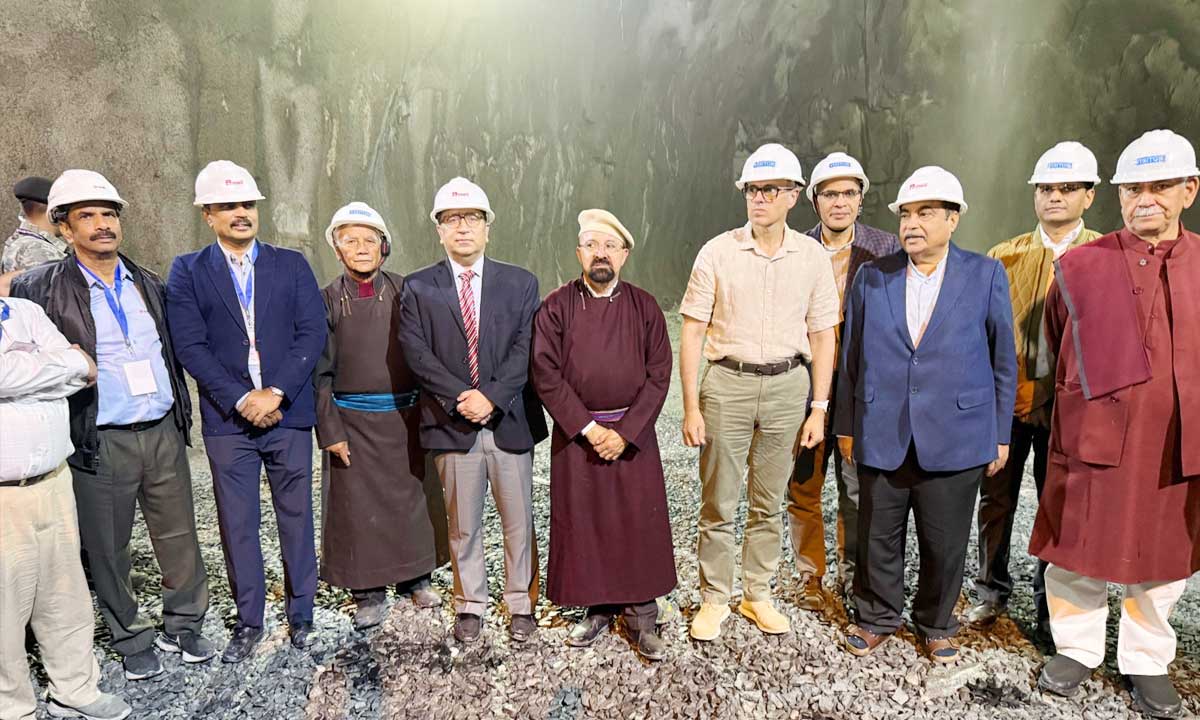
SRINAGAR/HYDERABAD, June 9: Megha Engineering & Infrastructure Limited (MEIL) has achieved the final breakthrough of the 13.153-kilometre Zojila Road Tunnel, marking a historic milestone in India’s infrastructure journey and bringing the dream of all-weather connectivity between Kashmir and Ladakh significantly closer to reality.
The breakthrough ceremony was held on Tuesday, June 9, in the presence of Union Minister for Road Transport and Highways Nitin Gadkari, Jammu & Kashmir Chief Minister Omar Abdullah, Lieutenant Governor Manoj Sinha, MEIL Group Managing Director P.V. Krishna Reddy, senior officials of NHIDCL, engineers, project staff and public representatives.
Constructed at an altitude of approximately 11,578 feet above sea level, the Zojila Tunnel is set to become the world’s longest single-tube bi-directional road tunnel at the highest altitude. The strategic project is being executed by MEIL for the National Highways & Infrastructure Development Corporation Limited (NHIDCL).
The tunnel stretches between Baltal in Kashmir and Meenamarg in Ladakh and is expected to transform connectivity along the Srinagar-Kargil-Leh highway, which remains closed for several months each year due to heavy snowfall and avalanche threats.
The final breakthrough signifies the completion of the most challenging excavation phase of the project. Excavation was carried out simultaneously from both ends of the tunnel through fragile Himalayan geology and under extreme weather conditions.
MEIL employed the New Austrian Tunnelling Method (NATM), a globally recognised technique designed for complex geological environments. The advanced methodology enabled continuous monitoring, enhanced safety measures and efficient progress despite difficult terrain and unpredictable rock formations.
Speaking on the occasion, Union Minister Nitin Gadkari described the achievement as a landmark moment in India’s infrastructure development.
“This is a historic day in India’s infrastructure story. The Zojila Tunnel will create a world record once operational and serve as a lifeline for the people of Ladakh and Jammu & Kashmir. The project showcases India’s engineering excellence and technical capabilities before the world,” he said.
Jammu & Kashmir Chief Minister Omar Abdullah said the breakthrough fulfilled a long-cherished dream of the people of the region.
“The people of Ladakh and Jammu & Kashmir have waited for this moment for decades. Improved connectivity will boost tourism, create economic opportunities and significantly improve the quality of life in the region,” he stated.
Lieutenant Governor Manoj Sinha termed the breakthrough a major step towards ensuring year-round access to Ladakh.
“The engineers and workers involved in this project have worked tirelessly under extremely challenging conditions. This tunnel will stand as a symbol of development, connectivity and national progress,” he said.
Apart from the main tunnel, the project includes approach roads, bridges, snow protection structures, cut-and-cover sections and other critical infrastructure components. Together, these elements form a comprehensive transport corridor designed to improve mobility, strengthen logistics and support economic growth in border regions.
The project has also achieved a significant safety milestone of 10 million safe man-hours, reflecting MEIL’s commitment to maintaining the highest standards of safety and quality during construction.
With the excavation phase now completed, the project will move into the next stages, including tunnel lining, finishing works, electro-mechanical installations and other operational preparations.
The Zojila Tunnel is widely regarded as one of India’s most ambitious and strategically important infrastructure projects. Once completed, it will provide seamless year-round connectivity between Kashmir and Ladakh, ending decades of seasonal isolation and opening a new chapter in Himalayan transportation infrastructure.


