
Will the World End on November 13, 2026? 1960s Scientific Prediction Sparks Debate on Social Media
Is the world really going to end on November 13, 2026? Is a prediction made by scientists in the 1960s about to come true? These questions have sparked discussions on social media, with various claims circulating about the possibility of a global catastrophe.

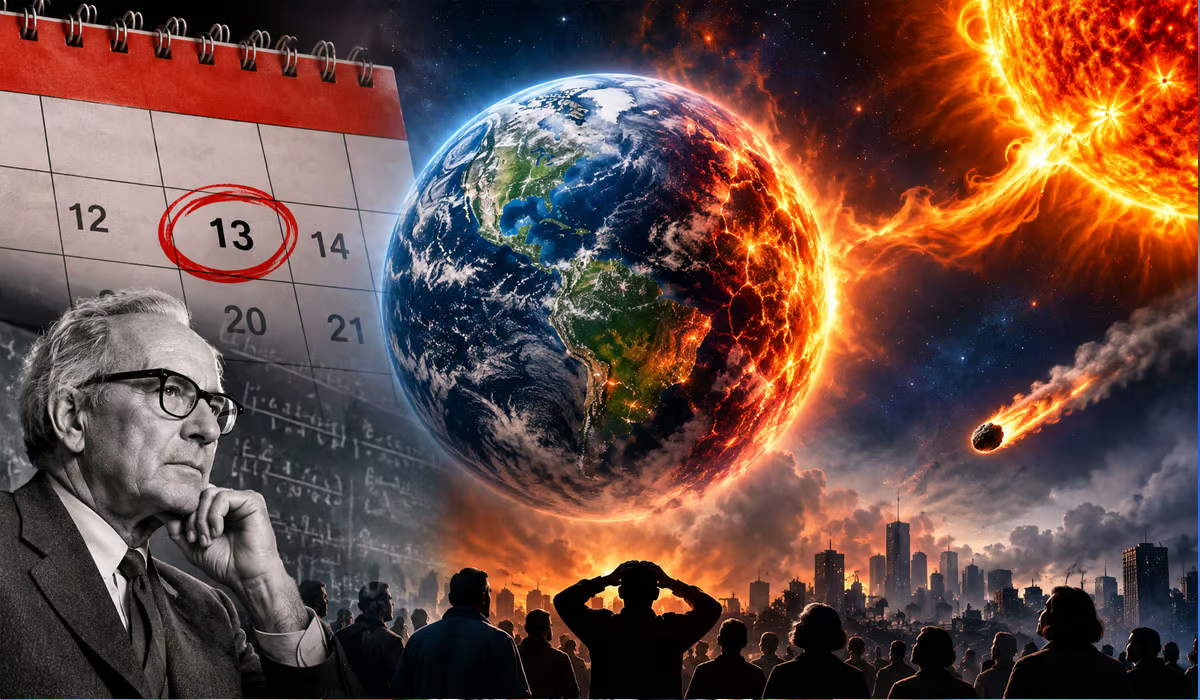
Is the world really going to end on November 13, 2026? Is a prediction made by scientists in the 1960s about to come true? These questions have sparked discussions on social media, with various claims circulating about the possibility of a global catastrophe.
However, experts say there is no reason to panic, as there is no credible scientific evidence supporting predictions about the end of the world on this date.
According to reports, scientists in the 1960s had expressed concerns over the rapidly increasing global population. They warned that if the population continued to grow at the same pace, agricultural production could eventually become insufficient to meet the food requirements of the world’s population, potentially leading to widespread hunger and food shortages.
In this connection, a research paper by Professor Heinz von Foerster and his team was published in the prestigious scientific journal Science in 1960. The paper was titled “Doomsday: Friday, 13 November, A.D. 2026.” Using mathematical calculations, the researchers suggested that the world’s population could reach a mathematically infinite level by November 13, 2026.
Follow for more details: munsifdaily.com
Professor Heinz von Foerster’s research examined the relationship between population growth and developments in food production, technology and industrial science. He proposed a mathematical formula based on the rate of population increase, which led to the identification of November 13, 2026, as a theoretical date.
Meanwhile, another claim attributed to geologist Dr Michael Tecla has also been circulating on social media. According to this claim, the Sun could release an unusually powerful burst of energy on November 13, 2026, potentially causing major disturbances in Earth’s magnetic field and widespread destruction.
However, scientists say there is no reliable evidence to support these claims. Professor von Foerster’s prediction was based on a mathematical model of population growth and was not a forecast of the actual destruction of the world. It does not mean that the global population will literally become infinite on November 13.
Similarly, solar activity occurs regularly, but there is no credible scientific evidence that the Sun will release energy on November 13 powerful enough to destroy the Earth.
Furthermore, space agencies and scientific institutions across the world continuously monitor the Sun, Earth and other celestial bodies. Modern scientific systems help researchers observe and assess potential threats from space.
Therefore, claims suggesting that the world will end on November 13, 2026, should not be treated as established facts. The mathematical prediction made in the 1960s should not be interpreted as a definite date for the end of the world.


