
Telangana Ready to Tackle El Niño: Minister Tummala Orders Three-Phase Action Plan to Protect Farmers
Telangana Agriculture Minister Tummala Nageswara Rao reviewed El Niño preparedness at ICRISAT and directed immediate implementation of a three-phase contingency plan, weekly agro-weather bulletins, and scientific measures to protect farmers during Kharif 2026.

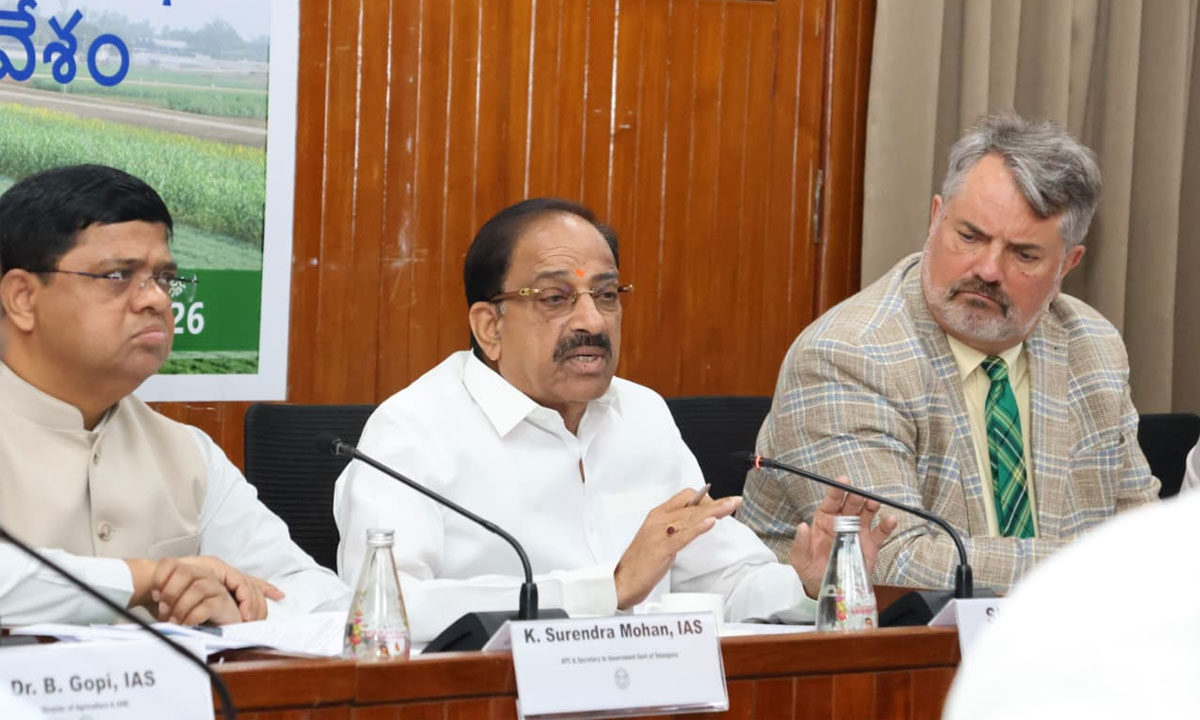

The Telangana Government is fully prepared to tackle the challenges posed by El Niño during the Kharif (Vanakalam) 2026 season, Agriculture Minister Tummala Nageswara Rao said on Monday after a high-level review meeting at ICRISAT, Hyderabad. Acting on the directions of Chief Minister A. Revanth Reddy, the Minister instructed officials to immediately implement the first phase of the state’s three-stage contingency plan to ensure that farmers do not suffer losses due to delayed rainfall or drought conditions.
Table of Contents
High-Level Review Held at ICRISAT
The review meeting was held at ICRISAT, Hyderabad, with participation from scientists and officials of:
- India Meteorological Department (IMD)
- Professor Jayashankar Telangana Agricultural University
- Indian Institute of Oilseeds Research (IIOR)
- Indian Institute of Millets Research (IIMR)
- Central Research Institute for Dryland Agriculture (CRIDA)
- Agriculture and allied departments
The meeting reviewed the three-phase contingency plans prepared by the Telangana Government based on the directions of Chief Minister A. Revanth Reddy. Scientists presented recommendations for managing El Niño conditions, including drought-resilient crops, crop varieties, and management practices for already sown crops.
Officials Directed to Reach Every Farmer
Addressing the meeting, Tummala Nageswara Rao instructed officials to ensure that every management practice recommended by scientists reaches farmers at the field level.
He directed District Collectors and officials of agriculture and allied departments to remain in the field continuously and closely monitor the situation in every district.
Three-Phase Contingency Plan for Delayed Rainfall
The Director of Agriculture informed the meeting that the contingency plan has been prepared in three phases based on the possibility of delayed rains, prolonged dry spells, and high temperatures due to El Niño.
The plan is based on the following dates:
- July 15
- July 30
- August 15
District-specific action plans have also been prepared.
The department estimated seed requirements as follows:
- 16.30 lakh quintals if rains are delayed until July 15
- 13.82 lakh quintals if rains are delayed until July 30
- 12.70 lakh quintals if drought conditions continue until August 15
The Minister said adequate arrangements have already been made to ensure these seeds are available in advance.
Rainfall Situation Across Telangana
The Minister directed the government to review rainfall conditions across all 33 districts every day.
According to the current report:
- 13 districts have received normal rainfall
- 20 districts are facing a rainfall deficit
He instructed District Collectors, agriculture officials, and scientists to jointly review conditions in drought-affected districts and immediately take necessary measures.
Dynamic District Specific Response (DSR) Strategy
The Minister directed officials to implement the Dynamic District Specific Response (DSR) system across Telangana using scientific methods.
The strategy includes:
- Real-time rainfall monitoring
- Weather-based agricultural advisories
- Soil moisture monitoring
- Crop growth assessment
- Climate risk analysis
- Alternative crop planning
- On-farm soil moisture conservation
- Crop diversification
Weekly Agro-Weather Bulletin for Every Mandal
To strengthen coordination among departments, the Minister directed the:
- India Meteorological Department (IMD)
- Irrigation Department
- Groundwater Department
- Electricity Department
- Agriculture Department
- Horticulture Department
to jointly issue a Weekly Agro-Weather Bulletin for every mandal until the end of August.
The bulletin will include:
- Mandal-wise rainfall
- Weekly and month-end weather forecasts
- Possibility of dry spells
- Maximum and minimum temperatures
- Soil moisture status
- Groundwater availability
- Irrigation water availability
- Electricity supply
- Crop conditions
- Farm management advisories
- Weather forecasts for irrigation project catchment areas
- Expected water storage, inflows, and irrigation availability
The Groundwater Department was instructed to provide updated mandal-wise groundwater information for water-use planning.
The Minister directed officials to widely distribute the bulletin through:
- Rythu Vedikas
- Gram Panchayats
- Agricultural Extension Officers
- WhatsApp groups
- Social media platforms
- Digital platforms
- Local media
Scientists Recommend Scientific Farm Practices
Scientists recommended that farmers should:
- Sow seeds only after sufficient soil moisture is available.
- Adopt Broad Bed and Furrow (BBF) or Ridge and Furrow methods.
- Delay fertilizer application until adequate soil moisture develops.
- Carry out frequent intercultivation to conserve soil moisture.
- Apply recommended doses of nitrogen and potash fertilizers only after rainfall.
- Provide life-saving irrigation during critical crop growth stages.
- Follow skip-row irrigation in row crops.
- Spray 2% urea or 1% Potassium Nitrate (KNO₃) solution during prolonged dry spells.
- Create one dead furrow every 3.6 metres to conserve rainwater.
- Use water stored in farm ponds when required.
- Promote intercropping.
- Follow weather-based agricultural advisories.
The Minister directed district officials to ensure these recommendations are fully implemented at the field level.
Special Advisory for Paddy Farmers
The Minister shared scientists’ recommendations for paddy farmers:
For farmers with nursery-stage paddy:
- Apply 800 grams of Carbofuran 3CG granules per acre one week before uprooting seedlings.
- Trim seedling leaf tips before transplantation.
- Transplant at 15 × 10 centimetres spacing.
- Maintain 6–8 seedlings per hill.
- Apply 25% additional nitrogen over the recommended dose.
- Apply 70% of total nitrogen during transplanting.
- Apply the remaining 30% at the panicle initiation stage.
- Adopt the Alternate Wetting and Drying (AWD) method to save water.
Farmers who have not yet transplanted paddy were advised to adopt Dry Direct Seeded Rice (DDSR) using short-duration varieties.
In canal command areas, depending on water availability, farmers were advised to consider alternative crops such as:
- Maize
- Bajra
- Ragi
- Red gram
- Green gram
- Sunflower
- Sesame
- Cowpea
- Vegetables
instead of paddy.
Advisory for Maize and Cotton Farmers
The Minister said maize and cotton crops are currently at the germination stage.
If dry conditions continue over the next two weeks, farmers should be advised to undertake weed control measures to conserve soil moisture.
No Shortage of Seeds or Fertilisers
The Minister said the government has completed a comprehensive assessment of seed and fertiliser requirements.
Required seeds have already been arranged according to the three-phase contingency plan.
He said MARKFED, seed organisations, and district administrations are working together to ensure there is no shortage for farmers.
Special El Niño Awareness Under ‘Rythu Nestham’
The Minister announced that the Rythu Nestham programme will create special awareness among farmers on:
- El Niño impacts
- Alternative cropping
- Water management
- Soil moisture conservation
- Weather-based farming
- Scientific management practices recommended by scientists
He said agriculture officials would guide farmers at the village level so that they can make decisions based on weather conditions.
The Minister said:
“No matter how severe the impact of El Niño is, we will take every necessary step to ensure that farmers do not suffer losses. Every farm management practice suggested by scientists must reach farmers at the field level, and district administrations must ensure their implementation. Every district administration has been alerted. Farmers need not worry. The government will stand by every farmer in every possible way.”
Officials Present
The meeting was attended by:
- Surendra Mohan, Agriculture Secretary
- Stanford Blade, Deputy Director General, ICRISAT
- Gopi, Director of Agriculture
- Yasmin Basha, Director of Horticulture
- Rahul Raj, Commissioner of Cooperation
- Chandrasekhar, HACA Managing Director
- Lakshmi, Warehousing Department Managing Director
- Jitesh Patil, TGSPDLC CMD
- Vice-Chancellors Janayya and Rajireddy of Agriculture and Horticulture Universities
- Harikishan, Principal Scientist, ICRISAT
- Other senior officials
The Telangana Government has launched a three-phase contingency plan to tackle El Niño and protect farmers during the Kharif 2026 season. Agriculture Minister Tummala Nageswara Rao, after a high-level review at ICRISAT, directed officials to implement the first phase immediately, issue weekly mandal-wise agro-weather bulletins, ensure no shortage of seeds and fertilisers, and take all scientific measures recommended by experts so that farmers do not suffer losses despite the rainfall deficit.
Follow MunsifNews24x7 for latest updates.