
SIR 2026: Pichhlon Ne Khata Ki Thi… Aglon Ne Saza Paayi
The purpose of revising electoral rolls should be simple: to ensure that every eligible citizen remains on the voters’ list and that ineligible names are removed. The Election Commission of India has also stated that the aim is to ensure that “no eligible citizen is left out while no ineligible person is included.”

Dr Rasia Nayeem Hashmi
The purpose of revising electoral rolls should be simple: to ensure that every eligible citizen remains on the voters’ list and that ineligible names are removed. The Election Commission of India has also stated that the aim is to ensure that “no eligible citizen is left out while no ineligible person is included.”
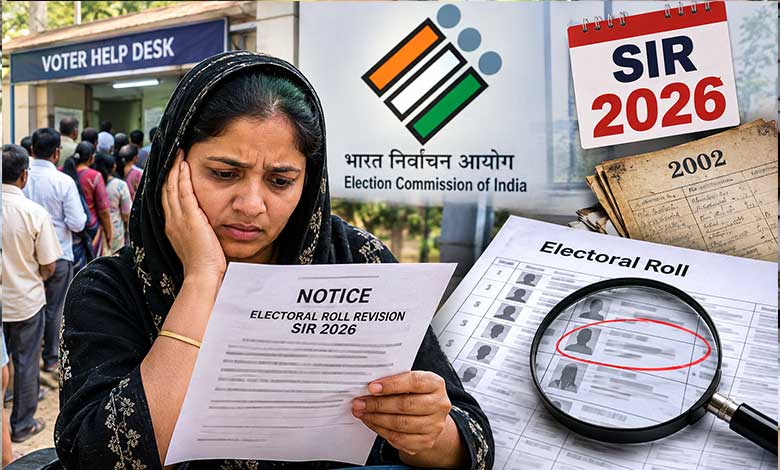
But for many ordinary voters, the present exercise is becoming a source of anxiety—not because they have done anything wrong, but because of mistakes made in electoral records more than two decades ago.
Consider a few cases that have come to light.
In one case, a woman was mapped with her *father. However, a notice was issued stating that the age difference between *the woman and her son was only 15 years, and she was asked to produce proof.
The question is obvious: How can a voter be held responsible for an apparent discrepancy created by the system’s interpretation of old records?
In another case, a man’s name in the 2002 electoral roll contained a simple spelling error—an “O” had been entered as a “D”. Because of this discrepancy, a notice was issued not only to him but also to his two children whose names had been mapped to his record.
Then there is the case of a voter who correctly opted for *self-mapping. However, because his name appeared with spelling mistakes in the 2002 electoral roll, the computer system apparently treated his mapping as *progeny mapping instead of self-mapping. He was then asked to produce documents relating to his parents.
The voter had done nothing wrong
The spelling mistake was not made by him. It had been made when the old electoral roll was prepared. The subsequent incorrect classification was also not his doing. Yet he is now being asked to deal with the consequences of both.
This is where the process becomes particularly frustrating.
When the voter approached the BLO, he was reportedly told that the BLO could not do much and that he should approach the ERO. But the ERO was not available to resolve the matter. The voter was ultimately told to wait and respond if another notice was issued.
What is an ordinary citizen supposed to do in such a situation?
Another voter found that, in the 2002 electoral roll, his own name had mistakenly been entered in the column meant for his father’s name. This too was clearly an old data-entry mistake. Yet he received a notice under the anomaly category.
He submitted the required documents. But even after doing so, the computer system reportedly continued to show that his mapping had been done through his progeny rather than through himself.
At this point, one cannot help asking:
Who is responsible for correcting an error that neither the voter created nor caused?
The 2002 records cannot be treated as perfect
The 2002 electoral roll is more than two decades old. At that time, electoral records were prepared in a very different manner. Names were written down and later entered into computer systems. Spelling mistakes, differences in the way names were written and other clerical errors were not unusual.
The Election Commission’s own voter-search system recognises that spelling variations may exist between old and current records and advises users to try different name variations while searching.
This is important.
A person whose name was incorrectly recorded more than 20 years ago cannot reasonably be expected to explain why a government record was entered incorrectly at that time.
More importantly, ordinary citizens in 2002 had no reason to imagine that a small spelling mistake in a voter list could create a serious problem for them decades later.
People simply did not know that an incorrect spelling, a wrong father’s name or an incomplete entry could one day become a major issue.
A computer can find an error, but it cannot always understand it
There is nothing wrong with using technology to make electoral-roll revision faster and more systematic.
But technology has its limits.
A computer can identify a mismatch. It cannot always understand the reason behind that mismatch.
A spelling difference does not necessarily mean that two records belong to different people.
An unusual age difference does not automatically mean that a relationship is wrong.
An incorrectly entered father’s name does not prove that the voter is someone else’s progeny.
And if a voter has opted for self-mapping, an old spelling mistake should not result in the system automatically treating the case as progeny mapping.
These are situations where human verification is necessary.
A computer-generated anomaly should therefore be treated as a reason to check the record—not as a reason to trouble the voter unnecessarily.
The strange irony: being absent from the old list may be easier than being present with an error
There is another curious aspect of the present situation.
People whose names are not found in the 2002 electoral roll and who receive notices under the unmapped category may, in some cases, be able to establish their eligibility through the prescribed procedure.
But those whose names are present in the old list but contain mistakes may face greater difficulties.
One person may have a spelling mistake.
Another may have the wrong father’s name.
Someone else may have an unusual age difference.
Another may have an old entry that was incorrectly understood by the computer system.
As a result, there are situations where a person whose name is completely missing from the old list may find it easier to clear the matter than someone whose name is actually present but contains a small mistake.
That is an irony that deserves serious attention.
The purpose of the exercise should be to make the electoral roll more accurate—not to make innocent voters suffer because of mistakes in old records.
BLOs also need support
The frustration of voters is understandable when they approach a BLO and are told, “We do not know; speak to the ERO.”
At the same time, it would be unfair to blame BLOs for everything.
BLOs are dealing with a large amount of work, repeated queries and considerable pressure. They too need clear instructions and proper support from higher authorities.
If a computer system generates an anomaly, the BLO should know exactly what he or she is expected to do.
Voters should not simply be told to wait for another notice.
There should be a clear procedure through which a genuine mistake can be explained and corrected without making the voter run from one office to another.
What is needed is common sense
The Election Commission and the concerned authorities should consider a simple principle:
A discrepancy should lead to verification, not unnecessary harassment.
If the only problem is a minor spelling difference, it should be possible to verify the person’s identity through other available records.
If the age difference between two family members appears unusual, the voter should be given a reasonable opportunity to explain it and provide supporting documents.
If a father’s name or another relative’s name was wrongly entered in the old electoral roll, the surrounding evidence should be examined instead of relying blindly on the incorrect entry.
And if a voter has opted for self-mapping but the computer has classified it differently because of an old spelling mistake, there should be a simple way for the authorised officer to correct it.
Most importantly, once a voter has submitted satisfactory documents, there should be a clear system for updating the record and correcting any wrong computer classification.
Citizens should not pay for mistakes they never made
There is a larger issue here.
A voter should not have to take repeated leave from work, leave household responsibilities, travel to a polling station or government office several times and stand in queues simply to correct an error that originated in an old government record.
Every additional visit has a cost.
For elderly people, daily-wage workers, women, persons with disabilities and those who have difficulty travelling, the burden can be even greater.
The purpose of electoral-roll revision is not only administrative accuracy. It is also to ensure that eligible citizens can participate in the democratic process without unnecessary difficulties.
Let the system correct its own mistakes
The Election Commission should therefore give clear instructions to field officials that minor spelling mistakes, reasonable age discrepancies and clerical errors in decades-old electoral records should not, by themselves, become a reason to trouble or reject a voter.
Each case should be looked at in its proper context.
If a voter can establish identity, relationship and eligibility through credible documents and other available evidence, the matter should be resolved through a simple verification process.
A citizen should not be forced to prove that a mistake made by a data-entry worker more than two decades ago was not his or her mistake.
Nor should a computer-generated classification be treated as unquestionable simply because it appears on a screen.
Computers can flag anomalies. Humans must resolve them.
The integrity of the electoral roll is undoubtedly important. But electoral integrity and the convenience of citizens are not opposing goals. A good system must protect both.
The Election Commission should ensure that its scrutiny process is strict where there are genuine irregularities, but reasonable and understanding when the problem is simply an old clerical or spelling mistake.
After all, the voter did not write the wrong spelling in the 2002 electoral roll.
The voter did not enter the wrong father’s name.
The voter did not design the computer system.
Why, then, should the voter bear the consequences of all three?
The answer should be a system that identifies the discrepancy, checks the available evidence, corrects the record and moves on—without turning an innocent citizen’s routine electoral verification into an unnecessary ordeal.


