
PM Modi unveils ‘Sapta Dhara’ vision, says it will drive India’s next growth phase
Prime Minister Narendra Modi, in his Independence Day address on Saturday, unveiled the concept of 'Sapta Dhara' (Seven Streams), describing seven key areas of strength that he said would provide India with the momentum and capabilities required to achieve the next level of growth and build a 'Viksit Bharat'.

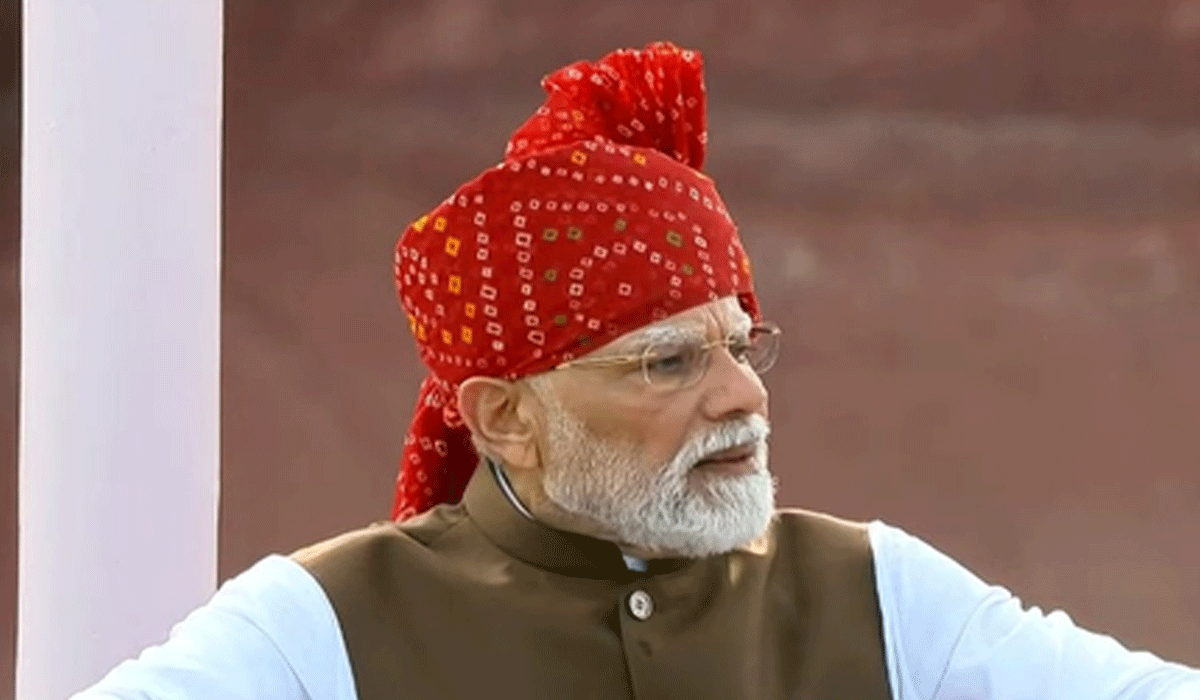
New Delhi: Prime Minister Narendra Modi, in his Independence Day address on Saturday, unveiled the concept of ‘Sapta Dhara’ (Seven Streams), describing seven key areas of strength that he said would provide India with the momentum and capabilities required to achieve the next level of growth and build a ‘Viksit Bharat’.
Addressing the nation from the ramparts of the Red Fort, PM Modi drew a comparison with the historical idea of ‘Sapta Sindhu’ (Seven Rivers), saying that India now needs a new current of development and national strength to realise its aspirations for a developed India.
“Today, I would also like to recall that era when the nation… when we knew, understood, and heard of India’s prowess in the form of the ‘Sapta Sindhu’ (Seven Rivers). Now, to build a Viksit Bharat, we need a new current. Today, from the ramparts of the Red Fort, I invoke the ‘Sapta Dhara’ of strength before the nation,” the Prime Minister said.
PM Modi said that the next five to seven years would be particularly important, adding that the combined strength of the seven streams could help India achieve in the coming years what could not be accomplished over several previous decades.
He said the country would also fully harness the power and potential of its youth and integrate their capabilities into the process of nation-building.
“Alongside this, the power and potential of our youth will be fully harnessed and integrated into nation-building. In the coming days, when I speak of Sapta Dhara, the very first stream of power is: Manufacturing Power. My dear fellow citizens, we need to significantly propel our manufacturing sector forward. Along with expanding production, we must manufacture both micro-components and large finished products. The entire value chain must belong to us, and we must carry it forward,” he said.
The Prime Minister stressed that India needs to develop not only individual components but also complete products and end-to-end manufacturing capabilities. From designing products to producing them, he said, India should establish itself as a “trusted global supply chain hub”.
“To my brothers and sisters working in the manufacturing sector — this is the right time, this is an opportunity. Do not let this opportunity slip away. To achieve this, we must meet global benchmarks in terms of Cost, Quality, and Scale. Our factories must be competitive, our products user-friendly, and our packaging appealing and attractive to people worldwide. ‘Zero Defect’ and precision manufacturing must become our defining identity,” he said.
PM Modi also emphasised the importance of maintaining international standards in manufacturing and called upon entrepreneurs, manufacturers and MSMEs to use the opportunity to expand India’s global footprint.
“When it comes to quality, there should be ‘No Compromise’. Therefore, our core mantra must be: ‘Quality, Quality, Quality’,” he added.
The second stream of the ‘Sapta Dhara’, according to PM Modi, is Agriculture and Food Production, along with large-scale Food Processing. He said India’s farmers now have access to expanding global markets and stressed the need to connect agricultural production with international demand.
“Today, world markets have opened up for our farmers. Because of optics and evolving demand, we are gaining access to a huge market; we need to reach there, and we must seize that space. We need to bridge the journey from farm to export market,” the Prime Minister said.
The third stream is Technology and Innovation, which PM Modi described as increasingly important in an era shaped by Artificial Intelligence, Quantum technology, space, robotics and data centres.
“Today is the era of AI, Quantum, Space, Robotics, and Data Centres. An entirely new landscape has unfolded. Emerging technologies are challenging us at every single moment. Therefore, India must not merely remain a consumer market for the world; we must become the Global Hub of Innovation,” he said.
PM Modi said India had already demonstrated its technological capabilities through UPI and digital public infrastructure and should now work towards taking its digital public technologies to every part of the world.
The fourth stream of the ‘Sapta Dhara’ is Gati Shakti, which encompasses infrastructure and connectivity.
“Through Gati Shakti, we must focus on seamless, high-speed connectivity across the country. We need to connect cities via high-speed rail, build modern highways, inland waterways, advanced airports, and robust multimodal logistics systems,” he added.
The fifth stream is Raksha Shakti, or Defence Power, which PM Modi said remains critical for India’s security and strategic autonomy. He stressed that achieving self-reliance in defence is essential and said India cannot continue to depend on other nations for its defence requirements.
“The importance of defence capability is paramount in every sense. My dear citizens, achieving Aatmanirbharta in defence is essential; India and the world have realised that there is no alternative. When the world looks out for itself, India cannot merely remain an arms market for other nations,” he said.
The Prime Minister said India must develop next-generation defence technologies and aim to become a Global Defence Supplier. He highlighted the need to develop capabilities in drone systems, counter-drone systems and hypersonic defence technologies.
He also pointed to cybersecurity as an increasingly important area of defence, saying that the capabilities and talent of India’s youth could be used to protect both the country and the wider world.
The sixth stream of the ‘Sapta Dhara’ is the Green Economy and Blue Economy, which PM Modi said would also create new employment opportunities through green jobs.
“We must achieve global scale in Green Hydrogen, Renewable Energy, Energy Storage, Green Mobility, and Green Manufacturing. While the world continues to deliberate on global warming, India is actively discovering pathways and providing practical solutions to challenges. India is leading with immense capability in the global Green Movement,” he said.
PM Modi also highlighted the opportunities available in the Blue Economy because of India’s extensive coastline. He said sectors such as fisheries, coastal tourism and ocean technologies could play an important role in India’s future economic growth.
The seventh and final stream of the ‘Sapta Dhara’ is India’s Soft Power, which the Prime Minister described as an area of immense importance not only for the country but also for the world.
“India’s soft power is truly immense. Today, Yoga has connected the entire world to India. Yoga is becoming a source of energy for humanity and a major pillar of trust in India. For a country rich with centres of faith, Ayurveda, holistic healthcare systems, and the ‘Heal in India’ initiative, we can showcase our strengths to the world through handicrafts, culture, films, our creative ecosystem, VFX, animation, gaming, and digital content. In the creative world, India can establish its pre-eminence,” PM Modi said.
He said India must develop its soft power into a global capability and use its cultural, creative and technological strengths to establish a stronger presence internationally.
“India has provided significant momentum to the WAVES Summit (World Audio Visual & Entertainment Summit), a platform the world eagerly looks forward to, presenting India’s soft power and creative talent to the entire world,” he added.
Through the ‘Sapta Dhara’ framework, PM Modi underlined the need for India to simultaneously strengthen manufacturing, agriculture, technology, infrastructure, defence, green and blue economies, and soft power as the country works towards achieving the broader vision of a ‘Viksit Bharat’.


