
Why Do Summer Rains and Hailstorms Occur? Scientific Reason Behind Heat Showers Explained
Why do summer rains and hailstorms occur? Learn the scientific reason behind heat showers, convection, and cumulonimbus clouds during peak summer.

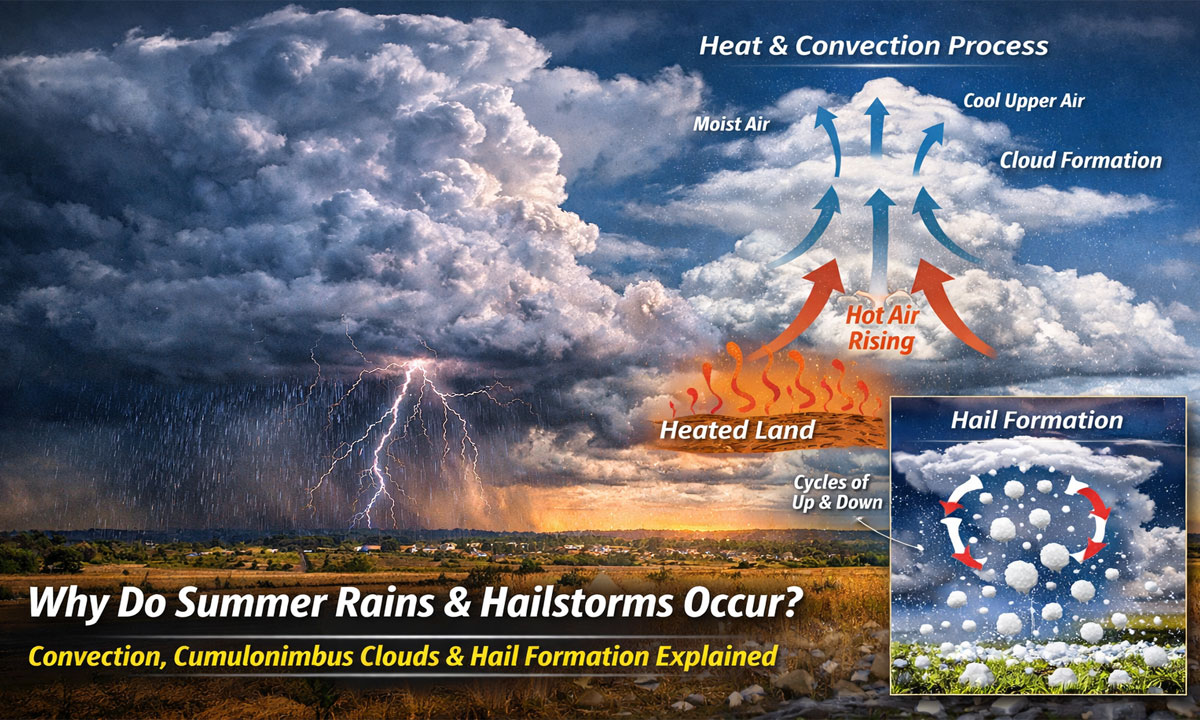
Summer is often linked with extreme heat, but summer rains and hailstorms are also common during this season due to scientific atmospheric processes. These sudden rains, known as heat showers, usually occur between March and June when temperatures are at their peak.
Table of Contents
The scientific reason behind summer rains and hailstorms lies in heat-driven atmospheric instability and cloud formation.
Role of Heat and Convection in Summer Rains
The main cause of summer rains is convection, a process driven by intense surface heating.
- During summer, the land heats up rapidly
- The air near the surface becomes hot and rises upward
- Cooler air replaces it, creating strong vertical air movement
- This process is called convection
As the rising air cools at higher altitudes, water vapor condenses to form clouds, leading to rainfall.
Formation of Cumulonimbus Clouds
The rising warm air leads to the formation of cumulonimbus clouds, which are responsible for thunderstorms and hailstorms.
Key features of these clouds:
- Grow vertically up to several kilometers
- Contain strong updrafts and downdrafts
- Produce heavy rain, lightning, strong winds, and hail
These clouds are most common during hot summer afternoons.
Scientific Process Behind Hailstorms
Hailstorms form inside cumulonimbus clouds through a well-known physical process:
- Strong updrafts carry water droplets high into cold regions of the cloud
- Droplets freeze into ice particles
- These particles are lifted repeatedly, forming multiple layers of ice
- When they become too heavy, they fall to the ground as hailstones
Some hailstones partially melt while falling due to warm air near the surface.
Why Summer is Peak Season for Heat Showers
The reason summer is ideal for heat showers and hailstorms is due to:
- High surface temperatures
- Strong convection currents
- Greater atmospheric instability
- Availability of moisture
These conditions are strongest between March and June, making it the peak period for such weather events.
Sudden Weather Changes in Summer
Due to these processes, people often experience:
- Sudden rainfall after intense heat
- Thunderstorms with lightning
- Gusty winds and occasional hail
These are natural outcomes of convection-driven weather systems.
Important Scientific Clarification
While summer is the most common season for heat showers, hailstorms can also occur in other seasons if similar atmospheric conditions develop. However, they are more frequent in summer due to stronger heating.
The scientific reason behind summer rains and hailstorms is convection, cumulonimbus cloud formation, and atmospheric instability caused by high temperatures. These heat showers are not random but are a result of well-understood weather processes.
Understanding why summer rains and hailstorms occur helps people stay aware and prepared for sudden weather changes during the hot season.
Follow MunsifNews24x7 for latest updates.


