
Trump outlines sweeping agenda ahead of midterms
Addressing a campaign rally in Syracuse, New York, Trump sought to make the November 3 elections a referendum on his administration's policies.

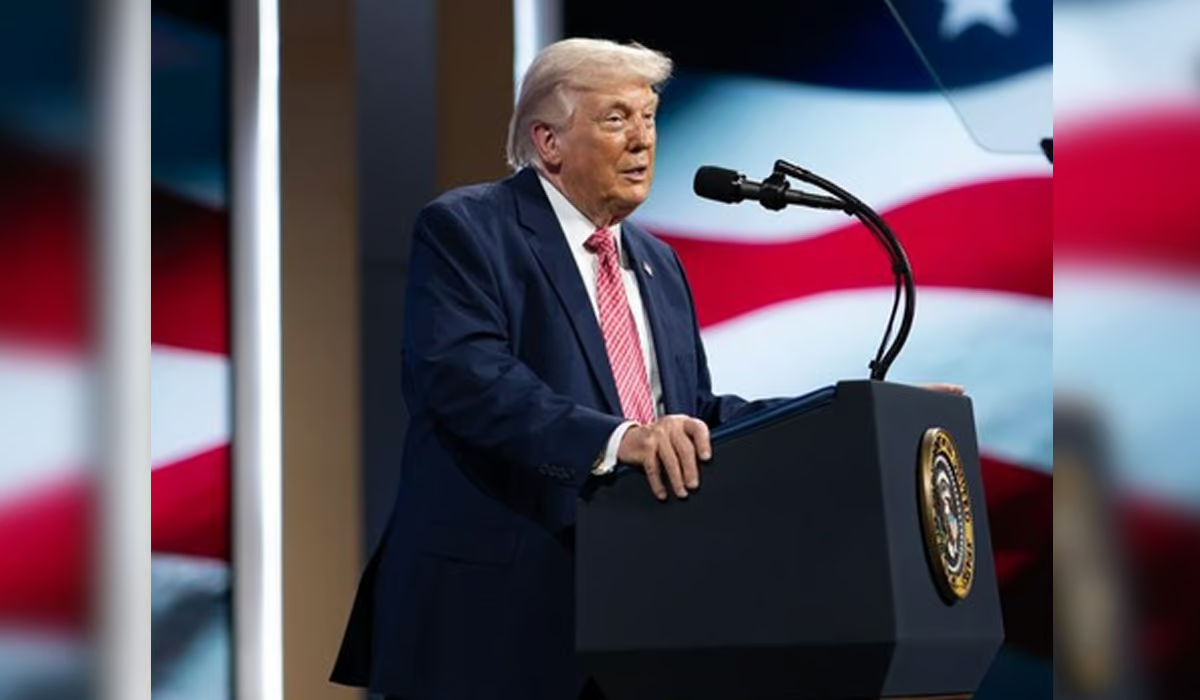

Washington: US President Donald Trump laid out an ambitious economic and legislative agenda ahead of next month’s congressional elections, promising cash payments to American citizens, tougher immigration enforcement, expanded tariffs and sweeping changes to healthcare and taxation if Republicans retain control of Congress.
Addressing a campaign rally in Syracuse, New York, Trump sought to make the November 3 elections a referendum on his administration’s policies. He proposed a $5,000 payment to every adult American citizen to a Republican victory in both the House of Representatives and Senate.
The President also pledged to strengthen border restrictions, make tax cuts permanent, overhaul healthcare payments and accelerate domestic manufacturing, while defending his administration’s handling of the conflicts involving Iran and Russia.
“If Republicans win the House of Representatives and the Senate, I am going to give all adult citizens in the United States of America $5,000 each,” Trump told supporters.
He said the proposed payment, which he described as a “Trump dividend”, would cost approximately $1 trillion and be financed through tariff revenues and economic growth.
“The only caveat on the Trump dividend is that you must spend your money in the United States of America,” he said.
The payment, as described by Trump, would be limited to adult American citizens, excluding non-citizens, including green-card holders and temporary visa workers.
Trump said his administration had secured more than $21 trillion in investment commitments, which he attributed largely to tariffs and incentives encouraging companies to manufacture in the United States.
“Tariffs are making us rich as hell,” he said, arguing that foreign manufacturers could avoid import duties by establishing production facilities in America.
He cited Micron’s planned semiconductor investment in central New York as an example of his administration’s manufacturing strategy.
“Micron is investing over $100 billion in creating 50,000 jobs in central New York,” Trump said.
The President did not distinguish between announced investment commitments and expenditure already undertaken.
He also said that more than one million federal government jobs had been eliminated, while employment in the private sector had expanded.
On immigration, Trump promised legislation intended to prevent future administrations from reversing his border enforcement policies.
He said Republicans would pursue the proposed No Invasion of Our Country Act and seek to prohibit sanctuary jurisdictions that limit cooperation with federal immigration authorities.
The President also renewed his demand for voter identification requirements and proof of citizenship in federal elections.
“We will pass the Save America Act to defend our sacred American elections that will include, of course, voter ID and proof of citizenship,” he said.
Trump accused Democratic-led states of failing to enforce immigration laws and allowing immigrants with criminal records to remain in American communities.
Turning to healthcare, Trump proposed redirecting federal payments from insurance companies to individuals, allowing them to purchase their own coverage.
He also promised to make permanent tax provisions involving tips, overtime income and Social Security benefits.
Separately, Trump said that more than 20 million senior citizens would receive payments of at least $100 each from funds his administration had identified within federal programmes.
On foreign policy, Trump asserted that the United States had secured control of the Strait of Hormuz and said increased oil shipments through the strategic waterway would help lower energy prices.
He also defended his agreement with Russian President Vladimir Putin to facilitate additional Russian diesel supplies, an arrangement that has drawn criticism from American lawmakers concerned about weakening economic pressure on Moscow over the Ukraine war.
Trump repeated his warning that Iran would not be permitted to acquire nuclear weapons and suggested that further military action remained possible if Tehran failed to meet American demands.
The rally also featured sharp attacks on New York Governor Kathy Hochul, whom Trump accused of mismanaging taxation, energy policy and public safety.


