
Supreme Court favours balanced approach over blanket firecracker ban ahead of Diwali
The Supreme Court on Monday said that public awareness and voluntary participation would be more effective in addressing the problem of firecracker-induced air pollution in Delhi-NCR than imposing restrictive orders that could be difficult to enforce on the ground.

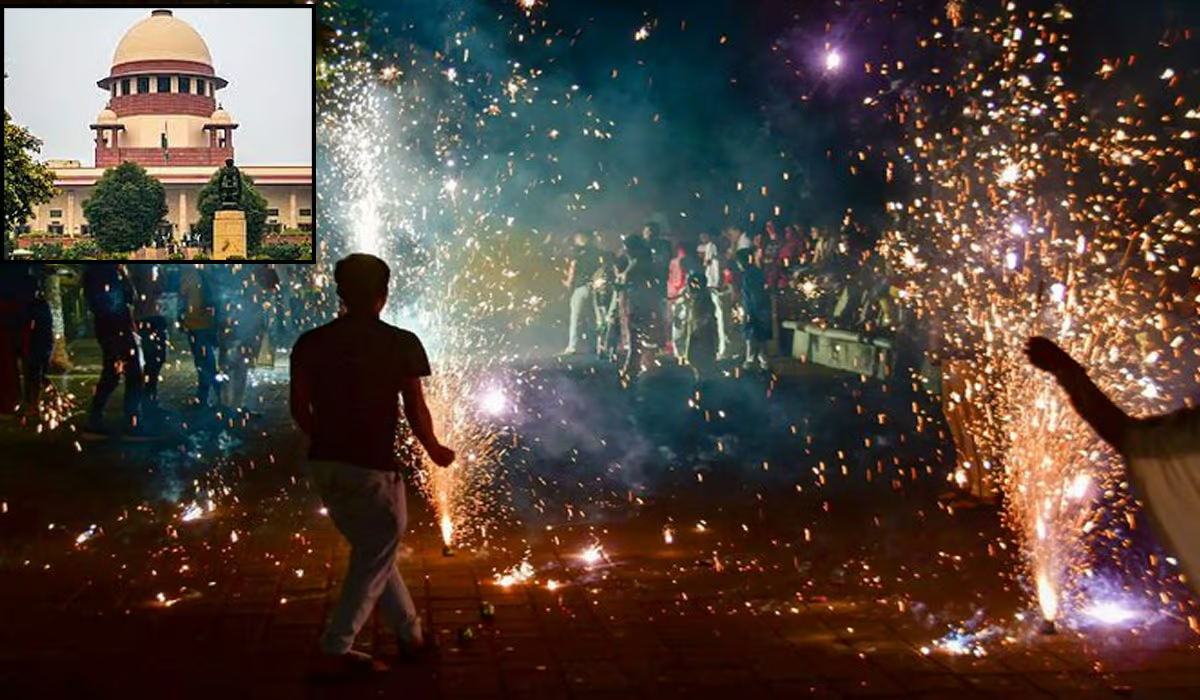

New Delhi: The Supreme Court on Monday said that public awareness and voluntary participation would be more effective in addressing the problem of firecracker-induced air pollution in Delhi-NCR than imposing restrictive orders that could be difficult to enforce on the ground.
A Bench of Chief Justice of India (CJI) Surya Kant and Justices Joymalya Bagchi and V. Mohana said the apex court would not hurt religious sentiments but stressed the need for a balanced and practical approach to minimise the harmful effects of firecrackers.
“We will not hurt religious sentiments, but at the same time, people should themselves come forward. The whole exercise should involve a balancing approach. If we adopt this balanced approach, society itself becomes awakened, and people come forward,” the CJI Kant-led Bench observed.
The Supreme Court was hearing suo motu proceedings concerning air pollution in Delhi-NCR, including the use of firecrackers, crop residue burning and solid waste management.
The CJI Kant-led Bench cautioned against passing restrictive orders without ensuring that they could be effectively implemented, observing that such directions were often perceived as coercive action.
“The only problem, and we are repeating this, is that the moment you pass an order, a restrictive order, people take it as if it is a kind of coercive action. It is a human reaction. We should be very practical and pragmatic in these things,” the apex court said.
It further said that sufficient time was available to make an earnest appeal to people to celebrate Diwali while limiting the bursting of firecrackers to specified hours, as had been done previously.
During the hearing, senior advocate Aparajita Singh, assisting the top court as amicus curiae, argued that firecrackers were not an essential part of religious observance and drew attention to their adverse impact on public health, particularly among children, elderly persons and those suffering from illnesses.
“Because fireworks are not part of religion; worship is! Firecrackers are not. Gods would be aghast if they knew that children are suffering and getting sick in their name,” she submitted.
Singh urged the apex court to refer the issue to the Commission for Air Quality Management (CAQM), which is responsible for coordinating air pollution control measures in Delhi-NCR, so that the available scientific material and medical concerns could be examined.
She also expressed reservations about restricting the use of firecrackers to one or two hours, contending that such limitations might not be effectively implemented. However, the Supreme Court stressed the importance of making citizens aware of the health hazards associated with firecrackers and encouraging them to voluntarily adopt less polluting practices.
“We have to make people wiser, bring awareness and tell them which firecrackers are harmful and which are less harmful. We should promote that kind of culture and persuade people to return to our original culture, where there were only sparklers and the lighting of lamps,” the CJI Kant-led Bench said.
It also suggested publishing educational material explaining the harmful consequences of firecracker use and encouraging people to minimise bursting and restrict it to particular hours to prevent air and noise pollution.
It further observed that authorities could consider regulating the availability of firecrackers in the market, allowing less harmful varieties while restricting the sale of those that cause greater pollution.
The matter has been posted for further hearing on October 15.
Earlier, on September 30, the Supreme Court ruled out a complete ban on firecrackers ahead of Diwali while indicating that their unrestricted use throughout the day would also not be permitted.
A Bench of Justices M.M. Sundresh and P.B. Varale had said that the top court needed to balance religious sentiments associated with Diwali against concerns over air pollution and its impact on children, elderly persons and those suffering from illnesses.
The apex court had also considered a proposal to permit specified categories of next-generation joint green crackers, subject to safeguards relating to their manufacture, noise levels, number and size of shells, and intervals between successive bursts. It had sought further assessment by expert bodies on barium-based firecrackers.


