
South African jurist Navi Pillay, who investigated genocide charges, conferred Nobel Peace Prize
Hailing from a family of Indian Tamil descent in Durban, Pillay, 85, who became the first non-white woman judge of the High Court of South Africa, has been awarded the prize "for her efforts to promote peace and international law".

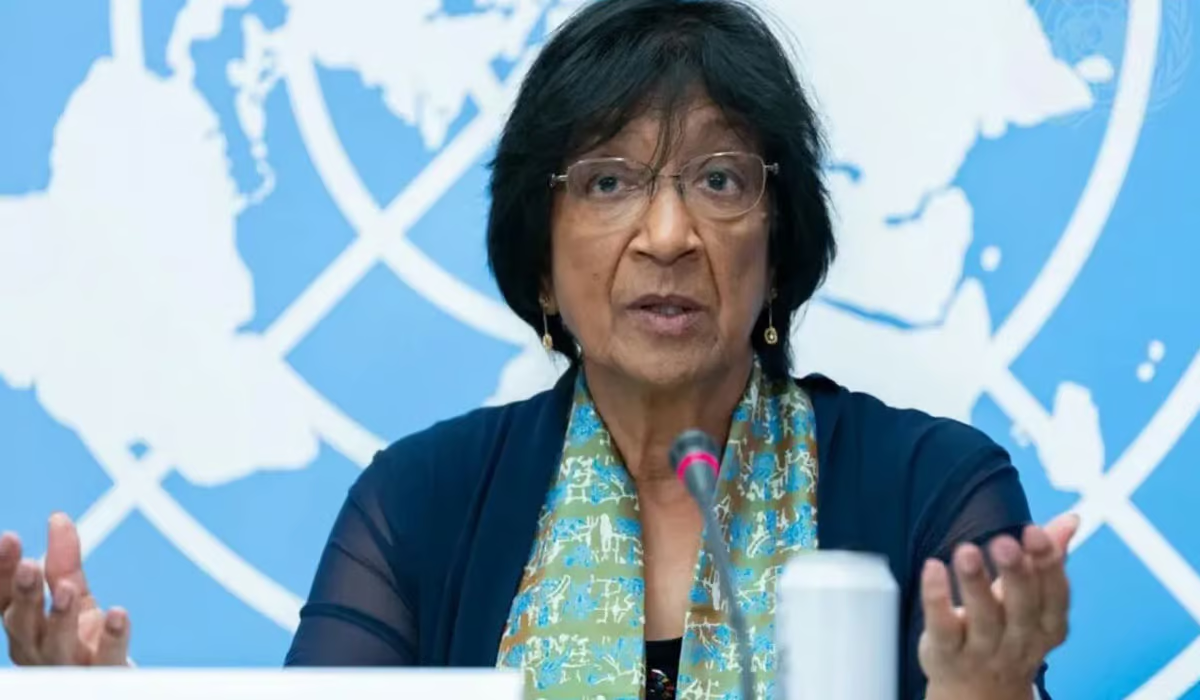

New Delhi: Recognising the contribution of international courts in upholding the rule of law and human rights amid indiscriminate conflicts, Indian-origin South African jurist Navanethem “Navi” Pillay, a former International Criminal Court judge and who investigated genocide claims in Rwanda, the occupied Palestinian territories, and Myanmar, was on Friday awarded the Nobel Peace Prize.
Hailing from a family of Indian Tamil descent in Durban, Pillay, 85, who became the first non-white woman judge of the High Court of South Africa, has been awarded the prize “for her efforts to promote peace and international law”.
Pillay has been at the forefront in the development of an international legal order, the Norwegian Nobel Committee, which selects the winner, said, according to the Nobel Prize website.
It said that it recognises her “role as a driving force in the development of an international system of law and order”, and highlighted her “judicial rigour, personal integrity, and considerable courage”.
“At a time when the number of wars and conflicts is rising, and when judges and institutions of international law are under political attack, the Nobel Committee wishes to issue a reminder that the ability to resolve conflicts without force or violence is dependent on the international rule of law. An international legal system in which war criminals are held to account, and the victims of abuse see justice served is a precondition for a peaceful world,” it said.
Pillay, who began her legal career by defending anti-apartheid activists and opened her own law firm in 1967. She came to notice as part of the defence team in a trial under the anti-terrorism act which exposed the use of torture and unlawful methods of interrogation.
She achieved another significant triumph in 1973 when she won a case for political prisoners on Robben Island, including Nelson Mandela, to have access to lawyers and some other basic rights.
Elevated to the High Court in 1995 after the end of the apartheid regime, Pillay, in 1999, became a judge and President of the International Criminal Tribunal for Rwanda (ICTR). Here, she stood by establishing, in the trial of Hutu leader Jean-Paul Akayesu, that rape and sexual violence would qualify as a war crime.
She was involved in another significant case which held that hate speech, particularly on mass media, would be liable to be tried as a war crime.
Pillay was then appointed a judge on the International Criminal Court (ICC) in 2003, but resigned in 2008, well before her term ended in 2012, to take over as the United Nations High Commissioner for Human Rights (OHCHR). Here, her four-year term (2008-12) was extended by another two years.
In 2019, she became an ad hoc judge on the International Court of Justice (ICJ) in the case brought by the West African nation of Gambi, accusing Myanmar of genocide. Hearings on the merits of the case were held and concluded in January this year.
In 2021, Pillay was appointed chair of the UN Independent International Commission of Inquiry on the Occupied Palestinian Territory, created after the May 2021 Israel–Palestinian clashes, and served until November 2025. The panel, in June 2024, held that war crimes have been committed both by Hamas and Israel in the wake of the October 2023 attacks, and in September 2025, indicted Israel for committing genocide in its Gaza operations.
Earlier in 2026, Pillay was also conferred the Olof Palme Prize, along with compatriot and legal scholar John Dugard.
Follow for more details: Munsifdaily.com


