
Supreme Court fixes January 21 hearing on Waqf Act challenges
Supreme Court Lists Waqf Amendment Act Challenge for January 21, 2027

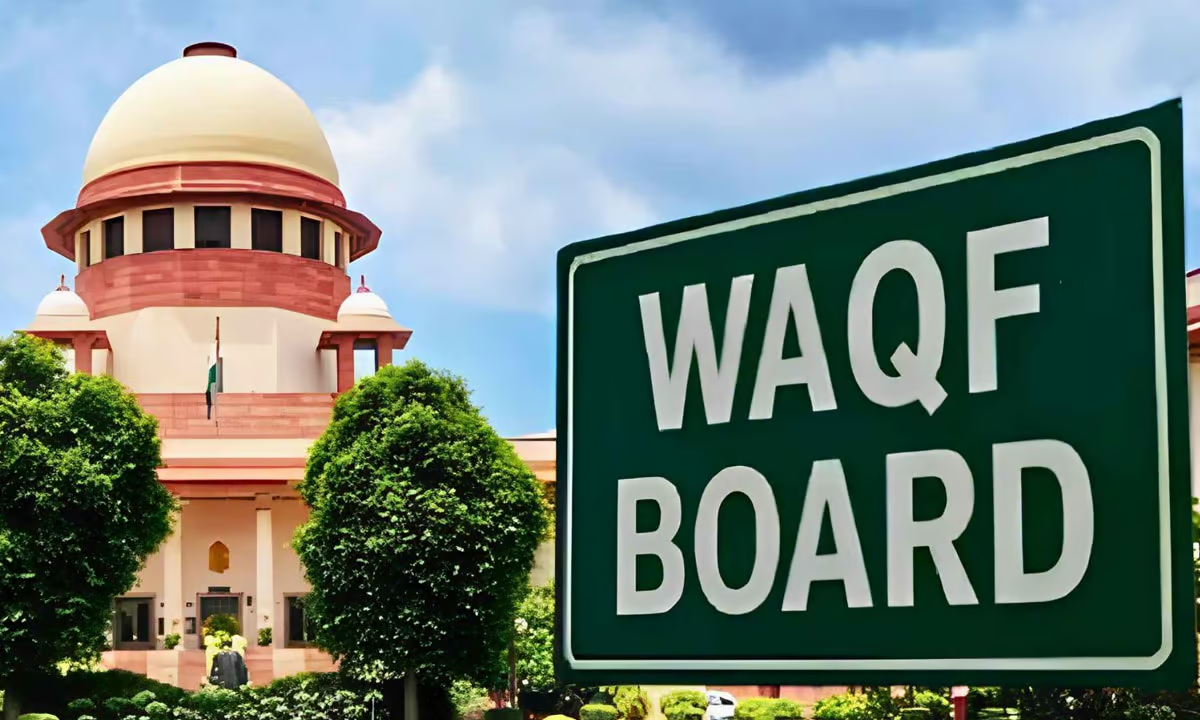
New Delhi: The Supreme Court on Tuesday scheduled January 21, 2027, for hearing petitions challenging the constitutional validity of the Waqf (Amendment) Act, 2025, and directed all parties to complete their pleadings by December 31, 2026.
A bench comprising Justices M.M. Sundresh and P.B. Varale also permitted applicants whose earlier petitions had been treated as interlocutory applications to file separate writ petitions within two weeks.
The court directed the nodal counsel to compile the judgments relied upon by the petitioners and asked the Additional Solicitor General to respond to their written submissions. The nodal counsel informed the bench that five petitions had earlier been designated as lead cases, while 135 others had been converted into interlocutory applications. Solicitor General Tushar Mehta, appearing for the Centre, referred to the earlier arrangement intended to prevent the proceedings from becoming unmanageable.
The earlier interim order of September 15, 2025, remains important to the case. The Supreme Court had declined to stay the entire amended law but temporarily suspended specific provisions. These include the requirement under Section 3(r) that a person must demonstrate at least five years of practising Islam before creating a Waqf, until state governments frame rules establishing a mechanism to determine eligibility. It also stayed the proviso to Section 3C(2), which prevented a property from being treated as Waqf until a designated officer submitted a report, and the related powers under Sections 3C(3) and 3C(4) to alter revenue records on the basis of the officer’s determination. Sci API+1
The court further directed that Waqf institutions should not be dispossessed of disputed properties, nor should entries in revenue records or Waqf Board records be altered, until the title dispute is finally decided by the Waqf Tribunal, subject to further orders of the High Court. No third-party rights can be created over such properties during the inquiry and adjudication process. Sci API+1
The amended law itself has not been stayed in its entirety. The interim directions also cap non-Muslim membership at four in the 22-member Central Waqf Council and three in each 11-member State Waqf Board. The court did not stay the provision allowing a non-Muslim to be appointed as a Waqf Board Chief Executive Officer, but said efforts should be made, as far as possible, to appoint someone from the Muslim community. Supreme Court+1
For Telangana, the membership limit applies to the State Waqf Board as well. However, Tuesday’s procedural order does not introduce a separate direction for the Telangana Waqf Board or decide the constitutional validity of any provision. The substantive legal questions remain pending.
The next hearing is scheduled for January 21, 2027, after completion of pleadings by December 31, 2026.


